This poem came to me, I believe, as a kind of counterbalance to the necessary activism of this moment in our country’s history. Each of us needs to take any actions we can to help thwart the encroaching authoritarianism of the Trump administration and to reclaim this country that we love. As a person of faith, I also rest in the knowledge that there is a Divine intention within all of creation, and that a part of my calling as a human being is to cooperate with what the Spirit is already doing in the world. There is a certain peace that comes in remembering that I am one among many who are doing this work of repairing the world, and that each of us brings our gifts to offer to the One who is Lord of all Creation.
A Familiar Peace
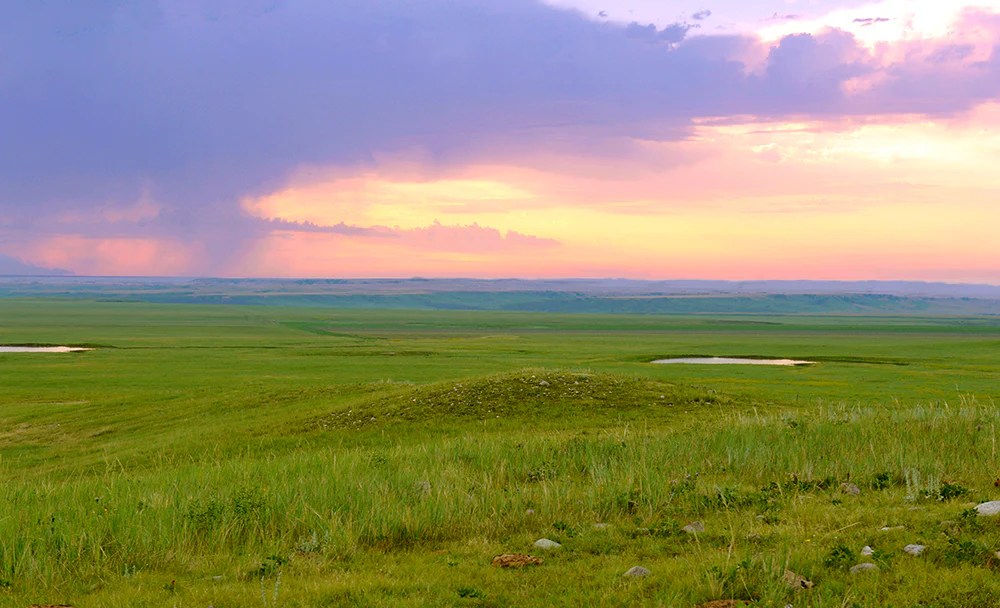
A light mist lingers over the prairie, releasing the purest scent of fall – a fragrant offering spreading gently over the wild greening fields.
This land holds a familiar peace, nestled among these forested hills, as pillowy clouds in shades of gray drift unhurried across the noiseless sky.
No threat of storm, no approaching calamity,
only the quiet calm of morning, the silence nearly audible,
an invitation to breathe.
What blessing rests here in the early hours of this day
to believe that all will be well, in the fullness of time,
Writing is self-therapy, a way to express what to me is true – maybe not empirically provable, or scientifically viable, but true in how it has shaped me and where it brings me to new awareness.
Skies are canvases painted by the Eternal One, birds are winged messengers from beyond, trees breathe and shimmer as though a poem.
Mountains rise in praise of Great Spirit, oceans teem with diversity, singing glory in many voices, creatures great and small are all our relations.
I am a minor player on life’s stage.
No one will remember me in a hundred years. What I’ve written will be lost to time.
For a moment though, I am a witness to life, aware of the cloud of witnesses who have preceded me, aware that we are all held in the eternal embrace of an Inexhaustible Love that has no beginning or end, aware that we are intimately bound together across borders and walls and geopolitical lines and that we in our finitude cannot undo what is timeless.
All of life is one.
When worry or fear seduce me, taunting me with my insignificance, I go in search of pen and paper where I can strip away the pretense of having any of this figured out.
Because for me at the end of the day it is enough to know truly know
Grace comes in birdsong rising on the wings of dawn from branches of white oak, ponderosa pine, quaking aspen – the bright, joyous sounds of our feathered relations.
Grace comes new every morning, hinting at heaven’s eternal song in which oceans swell and retreat, forests breathe, replenishing earth’s body, and waves of tall grass splash like surf in the summer-scented breeze.
This is how grace comes— untamed, unearned, unexplained but deeply felt – a stirring in the heart, a resting in the knowing.
In the fresh morning air grace catches up with you, fills your senses, buoys your spirit, and rouses you to life with its wild audacious nature.
(Interestingly, with the exception of indigenous native people, we all belong to one of the many streams of immigrants to this land)
We have in recent days witnessed the brutal tactics of ICE agents as they terrorize immigrants in the midst of normal daily activities, often detaining and removing them from their families in broad daylight. As I thought about the fear and confusion brought on by this state of affairs, I was moved to remind us of the sacred place the scriptures give to the stranger, the alien, the foreigner in our midst:
“Do not mistreat or oppress a foreigner, for you were once a foreigner in a strange land.” ~ Exodus 22:21
“The foreigner residing among you must be treated as your native-born. Love them as yourself, for you were foreigners in Egypt. I am the Lord your God.” ~ Leviticus 19:34
“For I was hungry, and you gave me food. I was thirsty, and you gave me drink. I was a stranger, and you welcomed me.” ~ Matthew 25:35
Then I penned the following blessing for my immigrant neighbors:
Bless the immigrants who play by the rules, who want only to provide for their families, who work hard in jobs most of us are not willing to do, who pay taxes, who contribute to the strength of our communities, who give love and laughter to their families and friends, who seek only to live in peace.
Bless the immigrants who fear daily for their safety, who become scapegoats for larger societal issues, who suffer the abuse of malignant policies and leaders, who must constantly look over their shoulders, who are the objects of continual ridicule, who are gravely misunderstood and maligned, who deserve our gratitude yet too often are met only with hostility.
Bless the immigrants, dear God, and protect them from the dangers and threats of this world.
Bless them and keep them, our sisters and brothers from other lands, languages, and cultures, that together with them we may experience life, liberty, and the pursuit of happiness, and together with them we may create the beloved community where all of God’s children are welcomed, in this place we all lovingly and gratefully call home.
A few weeks ago, I had the privilege of traveling back to Santa Barbara and presenting some reflections on Christmas to an ecumenical Christian group. The title of my presentation was:
The Word Becomes Flesh: Christmas as a Holy Invitation to Incarnational Living
It’s always good to begin with a story, so here’s one that’s been around:
Excited about Christmas, a little boy was finishing a letter to Santa with a list of the Christmas presents he badly wanted. And then, just to make sure he had covered all of his bases, he decided to send his Christmas wish list to Jesus as well. The letter to Jesus began, “Dear Jesus, I just want you to know that I’ve been good for six months now.” Then it occurred to him that Jesus knew this wasn’t true.
After a moment’s reflection, he crossed out “six months” and wrote “three months.” He thought some more, then crossed out “months” and replaced it with “weeks.” “I’ve been good for three weeks,” his letter now read. Realizing Jesus knew better than this, he put down his paper, went over to the Nativity set sitting on a table in his home, and picked up the figure of Mary. He then took out a clean piece of paper and began to write another letter: “Dear Jesus, if you ever want to see your mother again …”[i]
The Word Becomes Flesh: Christmas as a Holy Invitation to Incarnational Living
I titled my presentation before I really knew what I would say – I only knew that I wanted to reflect on what Christmas means to me. I’ve always thought of Christmas as an invitation – an invitation to more fully understand God’s deepest dreams for our lives and our world, that we might become more fully human and reflect the divine image within us, embracing just how unconditionally loved and accepted we are. Jesus is the exemplar of what it means to live a vibrant human life deeply connected to the Source of Life … the Divine Center!
Christmas is a season of special significance for those of us who follow the Christ of the Gospel. It is a season that brings to fulfillment the promises God made to humankind from the very beginning – that God comes near to us when our hearts are open and attuned to the Divine Presence. In the fullness of time, Jesus came near to us in human flesh and lived among us as the very revelation of God’s love, grace and peace. This Jesus of history becomes for those of us who believe the Christ of faith.
In Matthew’s account of Jesus’ birth, he quotes the prophet Isaiah, saying, “Look, the virgin shall conceive and bear a son, and they shall call him Emmanuel,” which means, “God is with us.” (Matt. 1:23) We use the word Incarnation to describe what we believe God has done – in God’s child Jesus the divine Word “becomes flesh.” It’s like having all the promises of scripture revealed in the clearest possible fashion as God is enfleshed in the Human One, Jesus of Nazareth.
How this happens remains a mystery, and I won’t try to further explain it. Rather I want to spend the next 20 minutes talking about why God would come to us in Jesus and what this incredible gift of Divine Life among us might mean for the ways we choose to live in this world!
As we approach Christmas, I encourage you to see this season as a holy invitation to incarnational living! As you contemplate the mystery of Emmanuel, “God with us,” in the days ahead, I hope you will begin to more fully celebrate all the ways you already believe that to be true – where you notice the nudges of the Holy in your life, where you experience God moments, where you glimpse the Sacred amid the ordinary moments of life, and where Grace becomes especially real and transparent to you as you move through each day.
Those of you who know me, know that I include poetry in just about anything I do, since the language of poetry is especially suited to convey mystery.
So, because we are in the season of Advent, we begin with a portion of a poem by Ann Weems, called “In Search of Our Kneeling Places”
In each heart lies a Bethlehem, an inn where we must ultimately answer whether there is room or not. When we are Bethlehem-bound we experience our own advent in his. … This Advent let’s go to Bethlehem and see this thing that the Lord has made known to us. In the midst of shopping sprees let’s ponder in our hearts the Gift of Gifts. … In the excitement and confusion, in the merry chaos, let’s listen for the brush of angels’ wings. This Advent, let’s go to Bethlehem and find our kneeling place.[ii]
We only begin to appreciate the Incarnation when we approach it from a place of awe as we kneel in wonder, prayer, and praise!
The life of a Christian is by definition a life that seeks to follow the Christ, and this act of following begins in adoration. So we need to find our kneeling place each morning as we set out on the journey of faith.
If the birth of the Christ child prompts within us a holy invitation to take up lives that incarnate the love of God, it’s wise to take some time to reflect more fully on how this kind of incarnational living is embodied or comes alive in us.
I want to suggest three possible ways of living incarnationally. They are, of course, not the only ways, just a start!
Incarnational living means recognizing the Divine Presence in all of creation, including you and me.
Richard Rohr – Franciscan priest, author, and teacher – whose work is grounded in practices of contemplation and compassion for the marginalized, writes that “the core message of the incarnation of God in Jesus is that the Divine Presence is here, in us and in all of creation, and not only ‘over there’ in some far-off realm.”[iii]
In 2 Peter 1:4, we read that God “has given us something very great and wonderful … we are able to share the divine nature!” Or, as The Message paraphrases this verse: “We were … given absolutely terrific promises to pass on to you—your tickets to participation in the life of God…”
So, the Divine Presence – the eternal Christ presence – is here in this place, in each one of us, and in all creation. There is a Life at the heart of all life that is holy. There is an essential interrelatedness in all that lives within God’s good creation. We are able to link our lives with the Divine Life. This is an amazing truth to contemplate, because it means that wherever we go the Divine Presence – the eternal Christ presence – is already there, and whatever we do we are potentially participating in the life of God.
I like how one modern-day teacher of Celtic wisdom, John Philip Newell, calls us to practice sacred imagination in our day. He believes that for the sake of our world we need “to truly wake up to the sacredness of the earth and every human being and do what we can to serve this sacredness in one another and the creatures” of this earth. He says we need “a consciousness of soul” to wake up to the sacred interrelationship of all things, “a strength of soul” to commit to live in accordance with this interrelationship, and “a beauty of soul” to be willing to serve this oneness with love, even at the cost of sacrifice.[iv]
So, in saying that incarnational living has to do with recognizing the Divine Presence in all of creation, we are saying that the gift of Christmas is that it invites us to expand our narrow vision of who and where God is. Jesus comes to help us see with compassionate eyes the whole world – a creation deeply and eternally loved by God! Christ is present among us to help us see how our lives are lovingly interconnected with all life on this swirling planet we call home!
II. Incarnational living means exercising your capacity for blessing.
You are an instrument of blessing from the very heart of God, for blessing is God’s incarnate love unleashed on the world. Think of Jesus blessing the disciples and commissioning them to go out and bless all they meet, even those who mean them harm (Luke 6:27-31). “Do to others as you would have them do to you,” Jesus commands. “Love your neighbor as yourself.”
Blessing is a commitment to truly seeing others. Has anyone ever said to you that they feel seen by you? Seeing someone as the unique person they are is an essential first step in blessing them.
Blessing literally means “to speak well of someone,”[v] and Jesus instructs us to do so whether that person is a friend, a stranger, or an enemy. Blessing is a way of communicating the amazing grace of God who pours out grace upon grace in our lives! “Life itself is grace,” Frederick Buechner likes to say. It is a “fathomless mystery.”[vi]So we need to listen with care to our own lives and to the lives of others as well.
“Listening is a form of worship,” says poet James Crew, “but you don’t have to kneel / on the floor with folded hands / or mouth the perfect prayer. / Just open the door of yourself / to another, become the space / they step through to show you / who they are. This is holiness: / two people seated together / on the pew of a park bench, / at the altar of a kitchen table. / Even if no one says a word / for a while, receive the silence / until it’s like a language / only the two of you can speak.”[vii]
Blessing is our gift to the world. We bless others by seeing them, by listening to their lives with them, and by giving away some of our own life so that they can experience more life.
Ronald Rolheiser compares the act of blessing to “a blessing grandmother or a blessing grandfather, not suffering but joyful, smiling and beaming with pride at the life and energy of the young, basking in that energy and radiating from every pore of his or her being the words of the Creator: ‘It is good! Indeed, it is very good! In you I take delight!’”[viii]
Still, blessing takes different forms at different times. When someone is grieving a deep loss in life, blessing needs to be filled with compassion. When my wife Dallis died four years ago, the book of blessings for times of grief written by Jan Richardson consoled me. Here’s one of her blessings, written following the death of her husband Gary, that may help you understand better the gift of blessing you have to offer someone as they wade through the troubled waters of grief.
Do not tell me there will be a blessing in the breaking, that it will ever be a grace to wake into this life so altered, this world so without.
Do not tell me of the blessing that will come in the absence.
Do not tell me that what does not kill me will make me strong or that God will not send me more than I can bear.
Do not tell me this will make me more compassionate, more loving, more holy.
Do not tell me this will make me more grateful for what I had.
Do not tell me I was lucky.
Do not even tell me there will be a blessing.
Give me instead the blessing of breathing with me.
Give me instead the blessing of sitting with me when you cannot think of what to say.
Give me instead the blessing of asking about him— how we met or what I loved most about the life we have shared; ask for a story or tell me one because a story is, finally, the only place on earth he lives now.
If you could know what grace lives in such a blessing, you would never cease to offer it.
If you could glimpse the solace and sweetness that abide there, you would never wonder if there was a blessing you could give that would be better than this – the blessing of your own heart opened and beating with mine.
No one escapes loss or grief in this life – it’s part of the human condition. Jesus knows the suffering of the human heart and he chooses to heal, to forgive, to love and to bless everyone he meets. In Jesus – “Emmanuel, God with us” – we see the compassionate heart of God for the world.
Shortly after I retired and moved to Ashland, I joined the spiritual care team at a local residential Hospice house. In our training, we learned that our role as volunteers was to be present, to be kind, and to be honest.Notice the phrasing “to be” rather than “to do.” In the company of those experiencing deep losses, it was important for us to understand our role as those who accompany another on life’s journey through death. These guidelines also seem to me to be a good philosophy for living in relationship with others in the spirit of Christ.
As we read the gospels, so often these are the ways that Jesus meets whoever is before him. He is presentwith them. He sees them exactly as they are, but through eyes of compassion. He is kind. He illumines the loving-kindness of God. And he is honest. He tells the truth without recrimination and only so that the one before him can recognize it and decide what they will do with it.
We who follow Christ have the capacity to bless others as well with our presence, our kindness, and our honesty. We can look upon the world with eyes of compassion for we know we have been recipients of such generous love ourselves. We can see others through the lens of grace for it is only grace that has saved us.
Incarnational living means breathing in the life of God and breathing out blessing for all that God has created and loved.
III. Incarnational living means doing the work of Christmas every day.
Christian preacher and teacher Tony Campolo once said, “Jesus never says to the poor: ‘come find the church’, but he says to those of us in the church: ‘go into the world and find the poor, hungry, homeless, imprisoned.”
Christmas is an invitation to follow Jesus into the world and embody the same kind of compassionate presence that he did. It’s an invitation to befriend the lonely, heal the broken, bless the one wounded by life. Incarnational living means picking up the mantle of Jesus’ ministry and letting it live through you. It is to “let the same mind be in you that was in Christ Jesus,” as we read in Philippians 2:5, and emptying yourself in order to serve those around you.
To mark the day when the Christmas season comes to an end on the feast of Epiphany, Howard Thurman, an African-American theologian, educator, and civil rights leader, wrote this benediction.
When the song of the angels is stilled, when the star in the sky is gone, when the kings and princes are home, when the shepherds are back with their flocks, the work of Christmas begins: to find the lost, to heal the broken, to feed the hungry, to release the prisoner, to rebuild the nations, to bring peace among the people, to make music in the heart.
“Jesus came to incarnate God’s presence and love to humanity. But before he left this earth, he called us to do the same in his name. Jesus’ followers are intended to put flesh on the invisible God, to incarnate God for the world. We know what this looks like because we see incarnation in Jesus as we read the Gospels. (The apostle) Paul … (calls) the church … ‘the body of Christ.’ We are the ongoing incarnation.”[xi]
We who seek to incarnate the unconditional love of God for the world can choose to live as justice-seeking, love-creating, truth-telling, hope-birthing people![xii]Or as biblical theologian Walter Brueggemann states it: “Like the ancient prophets, we are dispatched back to the good work entrusted to us. It is the work of peace-making. It is the work of truth-telling. It is the work of justice-doing. It is good work, but it requires our resolve to stay it, even in the face of forces to the contrary that are sure to prevail for a season.”[xiii]
Christmas is a holy invitation to:
recognize the Divine Presence in all of creation,
exercise your God-given capacity for blessing others, and
continue the good work of Christmas every day.
May we, by the grace of God, more fully embrace incarnational living this Christmas so that our lives are a blessing to others and to the world, showing forth the light and love of Christ!
Mark Lloyd Richardson
[i] Adam Hamilton, Incarnation: Rediscovering the Significance of Christmas (Nashville: Abingdon Press, 2020),pp. 46-7.
[ii] Ann Weems, Kneeling in Bethlehem (Philadelphia, The Westminster Press, 1980), p. 19.
[iii] Richard Rohr, The Universal Christ, p. 29. St. Athanasius (296-373) says that God reveals God’s Self everywhere in creation, “so that nothing was left devoid of his Divinity … so that ‘the whole universe was filled with the knowledge of the Lord as the waters fill the sea.’’” (Athanasius, De Incarnatione Verbi 45).
[iv] John Philip Newell, Sacred Earth Sacred Soul (New York: HarperCollins Publishers, 2021), p. 143.
[v] The English term “to bless” comes from Latin benedicere, literally “to speak well of” (as in bene – meaning well or good, and dicere – meaning to speak). Thus, at its root, to bless someone is to speak well of him or her.
[vi] Frederick Buechner, Listening to your Life: Daily Meditations with Frederick Buechner.
[vii] James Crew, poem “How to Listen,” San Luis Obispo County Arts Council email.
[viii] Ronald Rolheiser, Sacred Fire: A Vision for a Deeper Human and Christian Maturity (New York: Image, 2014), p. 242.
[ix] Jan Richardson, The Cure for Sorrows: A Book of Blessings for Times of Grief (Orlando, FL: Wanton Gospeller Press, 2016),pp. 53-4.
[x]The poem “The Work of Christmas” is from Howard Thurman’s The Mood of Christmas and Other Celebrations and is used by permission of Friends United Press. All rights reserved.
“Change is inevitable. Growth is optional.” ~ John Maxwell
Change is a constant on this human journey. Permanence can at times feel like an elusive dream.
Change arrives in many forms … … in the people we know … in the places we have grown to love … in our relationships with family and friends … in our own health and well-being … in cultural shifts and everchanging political winds … in our evolving perspectives on all things that matter
I admit that I’ve often longed for a greater sense of permanence in my life.
I have moved at least thirty times in my life … sometimes across town and sometimes across the country. During my childhood, I attended five elementary schools in six years across three different states. I’ve lived for a period of time in nine different states. I’ve lived in small rural farming towns, in big cities, in suburbs, in the desert, in coastal communities, and in the Hawaiian Islands.
My story is not necessarily unique, and I even believe that my experience of living in different places among diverse communities has broadened my awareness of the world and my place within it. In a certain respect, this diverse life experience has been a gift to me. Still, I sometimes envy those who have been in one place for years, even decades, and who reap the benefits of that longevity.
There’s a family I know in Santa Barbara who’ve been in that community for generations. They have deep roots and an abundance of interpersonal connections. They have an abiding sense of belonging and attachment to a community they love. There are plenty of other families with similar stories.
Yet for me, in every place I’ve lived, I’ve eventually had to say goodbye. And there is always a palpable sense of loss in the letting go.
Today I find myself at yet another life crossroads. I’ve met someone and she and I are envisioning a future with one another that has already begun beautifully to unfold. I am in the midst of selling my house in one community and moving to her community several hours north. And while I am committed to this new life adventure, there is a bittersweet note to it because of the people and the place I am leaving behind.
I don’t expect everyone to understand how I am feeling. I only know that my emotions have risen and fallen innumerable times over the past few years as I’ve dealt with the death of a spouse, the conclusion of forty years of active pastoral ministry, the new reality of being retired, moving to a community in another state where I knew two people upon arriving, and losing my mom soon thereafter.
It’s felt like nothing but change for a while now. I’m ready to settle down and find a rhythm of life that enables me to continue in paths of learning and service, and in bringing joy and encouragement into others’ lives wherever I choose to invest my time. At the same time, I’m not naïve. I realize there’s plenty of change still ahead for me.
So as I try to make sense out of all the change I am experiencing, I will take to heart the words of Alan Watts and simply “plunge into it, move with it, and join the dance.”
Or as the great jazz trumpeter, Miles Davis, once said, “It’s not about standing still and becoming safe. If anybody wants to keep creating, they have to be about change.”
“Life is a gift. But it is a gift shrouded in pain.” ~ Noel O’Donoghue
To walk in this world, to receive the gifts of earth and sea and sky, to hear the breath of our origins in the wind, to step upon the land of our ancestors, to greet creatures great and small in wonder, to listen with compassion to the earth’s memory, is to live.
Beauty is all around, in the ancient and the new, in places near and far away, in all paths that seek wholeness and peace, in all hearts that hold space for the other.
Beauty is within each one, beloved and valued by the Eternal Presence, bearing holiness in our intricately made bodies, birthing gentleness among the weary.
We carry sorrow too though. It is our companion through this life. The brokenness around us cannot be ignored. Neither can the brokenness within.
The pain of the inhumane. The pain of the neglected. The pain of the victims of violence. The pain of the discarded and unworthy.
The pain of injustice. The pain of separation. The pain of exclusion. The pain of indifference.
Suffering is all around, in the long ago and the near at hand, in places we know and those just beyond our reach, in all paths that sow division and fear, in all hearts that close themselves off.
Suffering is within each one, in the feeling of being lost or forsaken, removed from the deep love we once knew, in the harshness of life on the edge.
Yet may our love of life not be diminished.
Bless the suffering ones, O Lord, bind the wounded ones, bring peace to places of discord, encourage the despairing, gladden the hearts of the grieving, lend your light to all our paths.
Bless and protect the sacred gifts of life that flow in and among us, that all of us and indeed all of creation may one day worship at the altar where heaven and earth meet and all injury may be pardoned and all suffering be relieved and all brokenness be mended and all tears be wiped away.
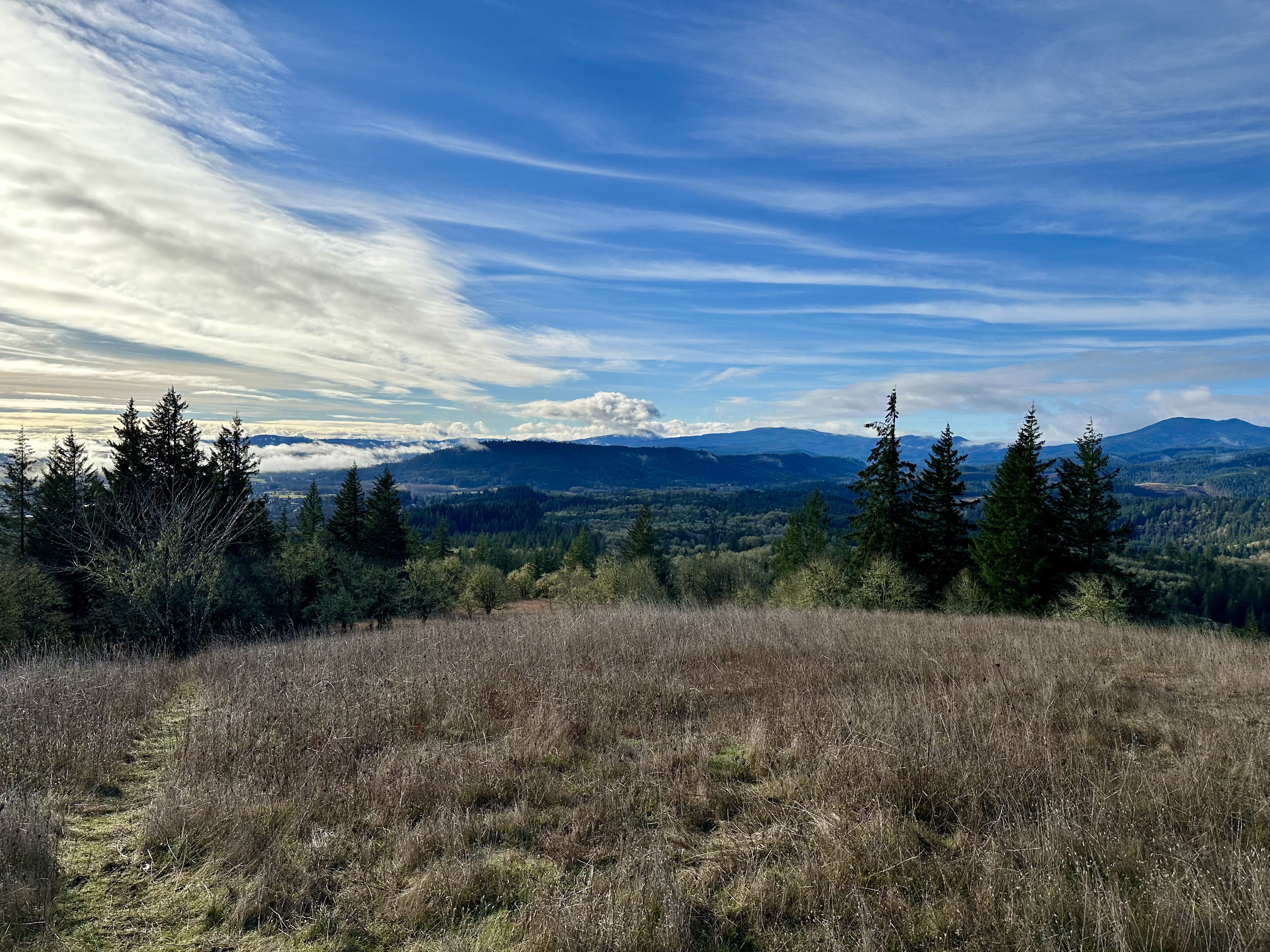
The trail feels steep today and leads me to an opening among pine and madrone, a vantage point above the green valley clothed in spring splendor and cradling the town that is becoming my home.
Purple Finch and Nashville Warbler trade gentle notes upon the breeze, back and forth, a call and response, their lively voices drenched in delight, never tiring of this celebration of living.
I pause to allow my breathing to still enough so I might receive a message birds seem singularly able to bestow, like blessings drifting down in consecration, alighting on the still restless places in my soul.
“To have memories, happy or sorrowful, is a blessing, for it shows we have lived our lives without reservation.” ~ Tan Twan Eng, The Gift of Rain
I remember the smile you wore when I first came to your door. I remember our first embrace, so full of yearning. I remember our first kiss, so full of delight. It was a tender time, wasn’t it? The sweetness held us, even as we revealed the pain that we each had known.
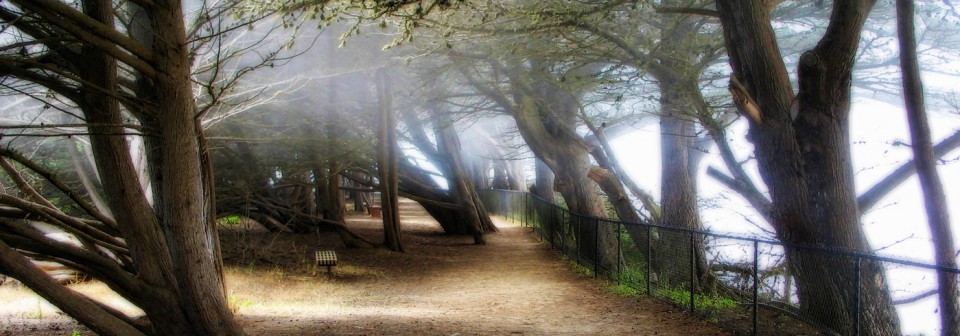
I remember lazy walks with you among pine and cypress trees, the ocean’s soft roar in the distance calling us.
I remember deep conversation interspersed with comfortable silences, as though our two souls needed time to breathe – to breathe in the fullness, the beauty, and the terror, of all we had experienced before meeting, all we were experiencing now with each other.
I remember quiet days and sleepless nights.
I remember worrying I might not be enough for you, confident you were everything I needed.
I remember you always being there for me, with a fierce and tender loyalty and love.
I remember making mistakes and being forgiven.
I remember the long waiting hours for the doctor to return from the operating room and invite me into a private space to talk. And I remember the distress I saw in her eyes as she delivered the awful news – your abdominal cavity was riddled with a rare form of cancer, they didn’t yet know its origin, but they had done their best to get all of it.
I remember the years of oncology visits and the many tests and scans and invasive procedures the medical world inflicted on your body to save you for another day, another month, another year.
I remember the silent toll it took on you, even as you wholeheartedly embraced each day of living.
I remember time – measured, sifted, scattered — that we received as gift and blessing.
I remember your hand slipping into mine whenever we walked.
I remember the places we still wanted to go together, the life we imagined living together.
I remember the times we were apart, wanting only to return to you.
I remember joy and sadness mingling so often as one.
I remember being deeply humbled and grateful to have you in my life.
I remember not being able to imagine your absence. And now, there is no need to imagine it. It meets me unwanted around every turn.
Mark Lloyd Richardson In memory of Dallis April 2024
After 40+ years of pastoral ministry, with most Sundays being taken up with worship and/or preaching responsibilities, today was different. As of two days ago, I am in the “retired relationship” with the California-Pacific Conference of the United Methodist Church. That’s what it is called: a “retired relationship.” In other words, there is a relationship that exists after these many years with a people who seek to live out their faith in this part of the world. It is a relationship of accountability and of blessing!
Today was different for me because I had no responsibility for any church matters. I had to consciously decide how to spend my morning. Always before it was decided for me. I had some thoughts, but nothing was really firm. Already, I guess, I am releasing myself from always having to have a definite plan. Have some ideas and see where you feel most called when the time comes. So although I thought I would be attending worship in person somewhere locally, when I woke up, I found my heart being tugged toward the ocean which has always been a restorative place for me.
So, I decided to attend worship online with the good people at Washington National Cathedral in D.C. They’re a few hours ahead, so I got to their website at 8 a.m. and waited for the Prelude to begin. It was quite an amazing worship service, including inspiring Gospel music, wonderful choral music, and a thought-provoking sermon.
Then it was off to the beach in Carpinteria (CA) for the morning, where it was cloudy and cool. The tide was in, and the waves were relatively calm. It was a lovely time to meander off as far as I could in one direction and just listen to the music of nature and watch the seabirds do their thing. Along the way I picked up some shells, rocks, and driftwood that looked interesting. Mostly though it was about being immersed again in the rhythm of life. About beginning a new chapter. About taking what I’ve learned and the relationships that continue to be a source of joy to me and moving into new ventures and new places.
The past forty years of pastoral work have naturally involved a lot of writing — mostly related to ministry with the constant need to write letters, articles, columns, sermons, and liturgy. Now the writing I do will have more to do with what feeds my soul and nourishes my spirit on any given day. Perhaps some of my writing will also be meaningful to someone else along the way. I expect, although I don’t know, that my writing will mostly be poetry, blessings, prayers, and reflections on the natural world and our place in it.




 dreamprayact