This poem came to me, I believe, as a kind of counterbalance to the necessary activism of this moment in our country’s history. Each of us needs to take any actions we can to help thwart the encroaching authoritarianism of the Trump administration and to reclaim this country that we love. As a person of faith, I also rest in the knowledge that there is a Divine intention within all of creation, and that a part of my calling as a human being is to cooperate with what the Spirit is already doing in the world. There is a certain peace that comes in remembering that I am one among many who are doing this work of repairing the world, and that each of us brings our gifts to offer to the One who is Lord of all Creation.
A Familiar Peace
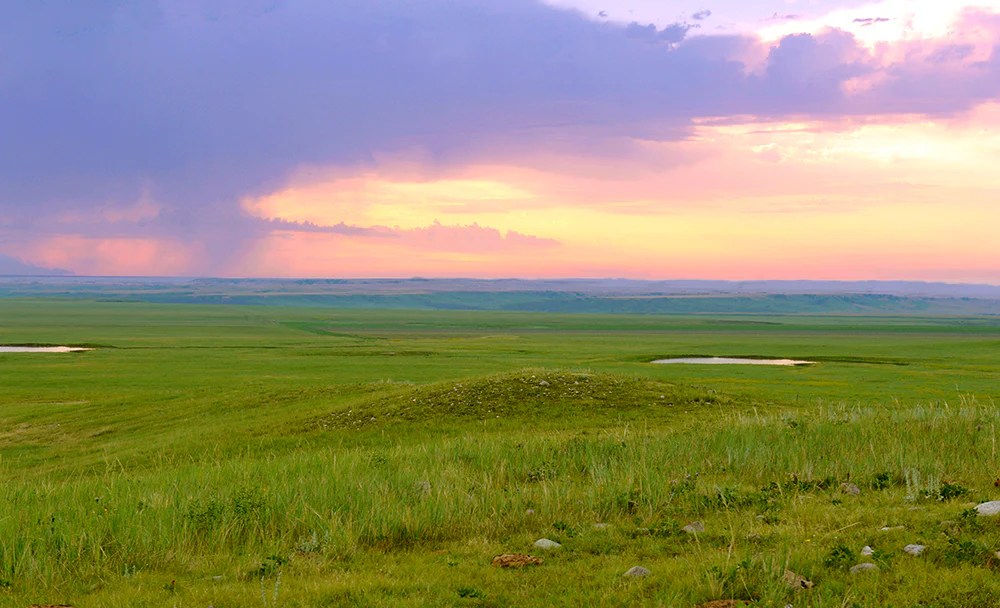
A light mist lingers over the prairie, releasing the purest scent of fall – a fragrant offering spreading gently over the wild greening fields.
This land holds a familiar peace, nestled among these forested hills, as pillowy clouds in shades of gray drift unhurried across the noiseless sky.
No threat of storm, no approaching calamity,
only the quiet calm of morning, the silence nearly audible,
an invitation to breathe.
What blessing rests here in the early hours of this day
to believe that all will be well, in the fullness of time,
Writing is self-therapy, a way to express what to me is true – maybe not empirically provable, or scientifically viable, but true in how it has shaped me and where it brings me to new awareness.
Skies are canvases painted by the Eternal One, birds are winged messengers from beyond, trees breathe and shimmer as though a poem.
Mountains rise in praise of Great Spirit, oceans teem with diversity, singing glory in many voices, creatures great and small are all our relations.
I am a minor player on life’s stage.
No one will remember me in a hundred years. What I’ve written will be lost to time.
For a moment though, I am a witness to life, aware of the cloud of witnesses who have preceded me, aware that we are all held in the eternal embrace of an Inexhaustible Love that has no beginning or end, aware that we are intimately bound together across borders and walls and geopolitical lines and that we in our finitude cannot undo what is timeless.
All of life is one.
When worry or fear seduce me, taunting me with my insignificance, I go in search of pen and paper where I can strip away the pretense of having any of this figured out.
Because for me at the end of the day it is enough to know truly know
Grace comes in birdsong rising on the wings of dawn from branches of white oak, ponderosa pine, quaking aspen – the bright, joyous sounds of our feathered relations.
Grace comes new every morning, hinting at heaven’s eternal song in which oceans swell and retreat, forests breathe, replenishing earth’s body, and waves of tall grass splash like surf in the summer-scented breeze.
This is how grace comes— untamed, unearned, unexplained but deeply felt – a stirring in the heart, a resting in the knowing.
In the fresh morning air grace catches up with you, fills your senses, buoys your spirit, and rouses you to life with its wild audacious nature.
A few weeks ago, I had the privilege of traveling back to Santa Barbara and presenting some reflections on Christmas to an ecumenical Christian group. The title of my presentation was:
The Word Becomes Flesh: Christmas as a Holy Invitation to Incarnational Living
It’s always good to begin with a story, so here’s one that’s been around:
Excited about Christmas, a little boy was finishing a letter to Santa with a list of the Christmas presents he badly wanted. And then, just to make sure he had covered all of his bases, he decided to send his Christmas wish list to Jesus as well. The letter to Jesus began, “Dear Jesus, I just want you to know that I’ve been good for six months now.” Then it occurred to him that Jesus knew this wasn’t true.
After a moment’s reflection, he crossed out “six months” and wrote “three months.” He thought some more, then crossed out “months” and replaced it with “weeks.” “I’ve been good for three weeks,” his letter now read. Realizing Jesus knew better than this, he put down his paper, went over to the Nativity set sitting on a table in his home, and picked up the figure of Mary. He then took out a clean piece of paper and began to write another letter: “Dear Jesus, if you ever want to see your mother again …”[i]
The Word Becomes Flesh: Christmas as a Holy Invitation to Incarnational Living
I titled my presentation before I really knew what I would say – I only knew that I wanted to reflect on what Christmas means to me. I’ve always thought of Christmas as an invitation – an invitation to more fully understand God’s deepest dreams for our lives and our world, that we might become more fully human and reflect the divine image within us, embracing just how unconditionally loved and accepted we are. Jesus is the exemplar of what it means to live a vibrant human life deeply connected to the Source of Life … the Divine Center!
Christmas is a season of special significance for those of us who follow the Christ of the Gospel. It is a season that brings to fulfillment the promises God made to humankind from the very beginning – that God comes near to us when our hearts are open and attuned to the Divine Presence. In the fullness of time, Jesus came near to us in human flesh and lived among us as the very revelation of God’s love, grace and peace. This Jesus of history becomes for those of us who believe the Christ of faith.
In Matthew’s account of Jesus’ birth, he quotes the prophet Isaiah, saying, “Look, the virgin shall conceive and bear a son, and they shall call him Emmanuel,” which means, “God is with us.” (Matt. 1:23) We use the word Incarnation to describe what we believe God has done – in God’s child Jesus the divine Word “becomes flesh.” It’s like having all the promises of scripture revealed in the clearest possible fashion as God is enfleshed in the Human One, Jesus of Nazareth.
How this happens remains a mystery, and I won’t try to further explain it. Rather I want to spend the next 20 minutes talking about why God would come to us in Jesus and what this incredible gift of Divine Life among us might mean for the ways we choose to live in this world!
As we approach Christmas, I encourage you to see this season as a holy invitation to incarnational living! As you contemplate the mystery of Emmanuel, “God with us,” in the days ahead, I hope you will begin to more fully celebrate all the ways you already believe that to be true – where you notice the nudges of the Holy in your life, where you experience God moments, where you glimpse the Sacred amid the ordinary moments of life, and where Grace becomes especially real and transparent to you as you move through each day.
Those of you who know me, know that I include poetry in just about anything I do, since the language of poetry is especially suited to convey mystery.
So, because we are in the season of Advent, we begin with a portion of a poem by Ann Weems, called “In Search of Our Kneeling Places”
In each heart lies a Bethlehem, an inn where we must ultimately answer whether there is room or not. When we are Bethlehem-bound we experience our own advent in his. … This Advent let’s go to Bethlehem and see this thing that the Lord has made known to us. In the midst of shopping sprees let’s ponder in our hearts the Gift of Gifts. … In the excitement and confusion, in the merry chaos, let’s listen for the brush of angels’ wings. This Advent, let’s go to Bethlehem and find our kneeling place.[ii]
We only begin to appreciate the Incarnation when we approach it from a place of awe as we kneel in wonder, prayer, and praise!
The life of a Christian is by definition a life that seeks to follow the Christ, and this act of following begins in adoration. So we need to find our kneeling place each morning as we set out on the journey of faith.
If the birth of the Christ child prompts within us a holy invitation to take up lives that incarnate the love of God, it’s wise to take some time to reflect more fully on how this kind of incarnational living is embodied or comes alive in us.
I want to suggest three possible ways of living incarnationally. They are, of course, not the only ways, just a start!
Incarnational living means recognizing the Divine Presence in all of creation, including you and me.
Richard Rohr – Franciscan priest, author, and teacher – whose work is grounded in practices of contemplation and compassion for the marginalized, writes that “the core message of the incarnation of God in Jesus is that the Divine Presence is here, in us and in all of creation, and not only ‘over there’ in some far-off realm.”[iii]
In 2 Peter 1:4, we read that God “has given us something very great and wonderful … we are able to share the divine nature!” Or, as The Message paraphrases this verse: “We were … given absolutely terrific promises to pass on to you—your tickets to participation in the life of God…”
So, the Divine Presence – the eternal Christ presence – is here in this place, in each one of us, and in all creation. There is a Life at the heart of all life that is holy. There is an essential interrelatedness in all that lives within God’s good creation. We are able to link our lives with the Divine Life. This is an amazing truth to contemplate, because it means that wherever we go the Divine Presence – the eternal Christ presence – is already there, and whatever we do we are potentially participating in the life of God.
I like how one modern-day teacher of Celtic wisdom, John Philip Newell, calls us to practice sacred imagination in our day. He believes that for the sake of our world we need “to truly wake up to the sacredness of the earth and every human being and do what we can to serve this sacredness in one another and the creatures” of this earth. He says we need “a consciousness of soul” to wake up to the sacred interrelationship of all things, “a strength of soul” to commit to live in accordance with this interrelationship, and “a beauty of soul” to be willing to serve this oneness with love, even at the cost of sacrifice.[iv]
So, in saying that incarnational living has to do with recognizing the Divine Presence in all of creation, we are saying that the gift of Christmas is that it invites us to expand our narrow vision of who and where God is. Jesus comes to help us see with compassionate eyes the whole world – a creation deeply and eternally loved by God! Christ is present among us to help us see how our lives are lovingly interconnected with all life on this swirling planet we call home!
II. Incarnational living means exercising your capacity for blessing.
You are an instrument of blessing from the very heart of God, for blessing is God’s incarnate love unleashed on the world. Think of Jesus blessing the disciples and commissioning them to go out and bless all they meet, even those who mean them harm (Luke 6:27-31). “Do to others as you would have them do to you,” Jesus commands. “Love your neighbor as yourself.”
Blessing is a commitment to truly seeing others. Has anyone ever said to you that they feel seen by you? Seeing someone as the unique person they are is an essential first step in blessing them.
Blessing literally means “to speak well of someone,”[v] and Jesus instructs us to do so whether that person is a friend, a stranger, or an enemy. Blessing is a way of communicating the amazing grace of God who pours out grace upon grace in our lives! “Life itself is grace,” Frederick Buechner likes to say. It is a “fathomless mystery.”[vi]So we need to listen with care to our own lives and to the lives of others as well.
“Listening is a form of worship,” says poet James Crew, “but you don’t have to kneel / on the floor with folded hands / or mouth the perfect prayer. / Just open the door of yourself / to another, become the space / they step through to show you / who they are. This is holiness: / two people seated together / on the pew of a park bench, / at the altar of a kitchen table. / Even if no one says a word / for a while, receive the silence / until it’s like a language / only the two of you can speak.”[vii]
Blessing is our gift to the world. We bless others by seeing them, by listening to their lives with them, and by giving away some of our own life so that they can experience more life.
Ronald Rolheiser compares the act of blessing to “a blessing grandmother or a blessing grandfather, not suffering but joyful, smiling and beaming with pride at the life and energy of the young, basking in that energy and radiating from every pore of his or her being the words of the Creator: ‘It is good! Indeed, it is very good! In you I take delight!’”[viii]
Still, blessing takes different forms at different times. When someone is grieving a deep loss in life, blessing needs to be filled with compassion. When my wife Dallis died four years ago, the book of blessings for times of grief written by Jan Richardson consoled me. Here’s one of her blessings, written following the death of her husband Gary, that may help you understand better the gift of blessing you have to offer someone as they wade through the troubled waters of grief.
Do not tell me there will be a blessing in the breaking, that it will ever be a grace to wake into this life so altered, this world so without.
Do not tell me of the blessing that will come in the absence.
Do not tell me that what does not kill me will make me strong or that God will not send me more than I can bear.
Do not tell me this will make me more compassionate, more loving, more holy.
Do not tell me this will make me more grateful for what I had.
Do not tell me I was lucky.
Do not even tell me there will be a blessing.
Give me instead the blessing of breathing with me.
Give me instead the blessing of sitting with me when you cannot think of what to say.
Give me instead the blessing of asking about him— how we met or what I loved most about the life we have shared; ask for a story or tell me one because a story is, finally, the only place on earth he lives now.
If you could know what grace lives in such a blessing, you would never cease to offer it.
If you could glimpse the solace and sweetness that abide there, you would never wonder if there was a blessing you could give that would be better than this – the blessing of your own heart opened and beating with mine.
No one escapes loss or grief in this life – it’s part of the human condition. Jesus knows the suffering of the human heart and he chooses to heal, to forgive, to love and to bless everyone he meets. In Jesus – “Emmanuel, God with us” – we see the compassionate heart of God for the world.
Shortly after I retired and moved to Ashland, I joined the spiritual care team at a local residential Hospice house. In our training, we learned that our role as volunteers was to be present, to be kind, and to be honest.Notice the phrasing “to be” rather than “to do.” In the company of those experiencing deep losses, it was important for us to understand our role as those who accompany another on life’s journey through death. These guidelines also seem to me to be a good philosophy for living in relationship with others in the spirit of Christ.
As we read the gospels, so often these are the ways that Jesus meets whoever is before him. He is presentwith them. He sees them exactly as they are, but through eyes of compassion. He is kind. He illumines the loving-kindness of God. And he is honest. He tells the truth without recrimination and only so that the one before him can recognize it and decide what they will do with it.
We who follow Christ have the capacity to bless others as well with our presence, our kindness, and our honesty. We can look upon the world with eyes of compassion for we know we have been recipients of such generous love ourselves. We can see others through the lens of grace for it is only grace that has saved us.
Incarnational living means breathing in the life of God and breathing out blessing for all that God has created and loved.
III. Incarnational living means doing the work of Christmas every day.
Christian preacher and teacher Tony Campolo once said, “Jesus never says to the poor: ‘come find the church’, but he says to those of us in the church: ‘go into the world and find the poor, hungry, homeless, imprisoned.”
Christmas is an invitation to follow Jesus into the world and embody the same kind of compassionate presence that he did. It’s an invitation to befriend the lonely, heal the broken, bless the one wounded by life. Incarnational living means picking up the mantle of Jesus’ ministry and letting it live through you. It is to “let the same mind be in you that was in Christ Jesus,” as we read in Philippians 2:5, and emptying yourself in order to serve those around you.
To mark the day when the Christmas season comes to an end on the feast of Epiphany, Howard Thurman, an African-American theologian, educator, and civil rights leader, wrote this benediction.
When the song of the angels is stilled, when the star in the sky is gone, when the kings and princes are home, when the shepherds are back with their flocks, the work of Christmas begins: to find the lost, to heal the broken, to feed the hungry, to release the prisoner, to rebuild the nations, to bring peace among the people, to make music in the heart.
“Jesus came to incarnate God’s presence and love to humanity. But before he left this earth, he called us to do the same in his name. Jesus’ followers are intended to put flesh on the invisible God, to incarnate God for the world. We know what this looks like because we see incarnation in Jesus as we read the Gospels. (The apostle) Paul … (calls) the church … ‘the body of Christ.’ We are the ongoing incarnation.”[xi]
We who seek to incarnate the unconditional love of God for the world can choose to live as justice-seeking, love-creating, truth-telling, hope-birthing people![xii]Or as biblical theologian Walter Brueggemann states it: “Like the ancient prophets, we are dispatched back to the good work entrusted to us. It is the work of peace-making. It is the work of truth-telling. It is the work of justice-doing. It is good work, but it requires our resolve to stay it, even in the face of forces to the contrary that are sure to prevail for a season.”[xiii]
Christmas is a holy invitation to:
recognize the Divine Presence in all of creation,
exercise your God-given capacity for blessing others, and
continue the good work of Christmas every day.
May we, by the grace of God, more fully embrace incarnational living this Christmas so that our lives are a blessing to others and to the world, showing forth the light and love of Christ!
Mark Lloyd Richardson
[i] Adam Hamilton, Incarnation: Rediscovering the Significance of Christmas (Nashville: Abingdon Press, 2020),pp. 46-7.
[ii] Ann Weems, Kneeling in Bethlehem (Philadelphia, The Westminster Press, 1980), p. 19.
[iii] Richard Rohr, The Universal Christ, p. 29. St. Athanasius (296-373) says that God reveals God’s Self everywhere in creation, “so that nothing was left devoid of his Divinity … so that ‘the whole universe was filled with the knowledge of the Lord as the waters fill the sea.’’” (Athanasius, De Incarnatione Verbi 45).
[iv] John Philip Newell, Sacred Earth Sacred Soul (New York: HarperCollins Publishers, 2021), p. 143.
[v] The English term “to bless” comes from Latin benedicere, literally “to speak well of” (as in bene – meaning well or good, and dicere – meaning to speak). Thus, at its root, to bless someone is to speak well of him or her.
[vi] Frederick Buechner, Listening to your Life: Daily Meditations with Frederick Buechner.
[vii] James Crew, poem “How to Listen,” San Luis Obispo County Arts Council email.
[viii] Ronald Rolheiser, Sacred Fire: A Vision for a Deeper Human and Christian Maturity (New York: Image, 2014), p. 242.
[ix] Jan Richardson, The Cure for Sorrows: A Book of Blessings for Times of Grief (Orlando, FL: Wanton Gospeller Press, 2016),pp. 53-4.
[x]The poem “The Work of Christmas” is from Howard Thurman’s The Mood of Christmas and Other Celebrations and is used by permission of Friends United Press. All rights reserved.
The trail feels steep today and leads me to an opening among pine and madrone, a vantage point above the green valley clothed in spring splendor and cradling the town that is becoming my home.
Purple Finch and Nashville Warbler trade gentle notes upon the breeze, back and forth, a call and response, their lively voices drenched in delight, never tiring of this celebration of living.
I pause to allow my breathing to still enough so I might receive a message birds seem singularly able to bestow, like blessings drifting down in consecration, alighting on the still restless places in my soul.
The recording on my phone from a near and distant day says only New Recording 3— not much to go on.
I haven’t heard it in years since standing in a throng of preachers inside a packed sanctuary in Minneapolis singing together a beloved Spiritual before the Gospel is to be read.
At first, I struggle to remember – where is this? why am I recording this? what moved me to preserve these particular moments?
Precious Lord, take my hand, lead me on, let me stand, I am tired, I am weak, I am worn; through the storm, through the night, lead me on to the light: Take my hand, precious Lord, lead me home.
These words, these timeless words… oh, how they soothe the soul. Loved by so many, they are words that smooth over the hard edges of this life, holding us at least for a time in the safekeeping of holy love.
As I listen they do that for me as they have for generations of light-seekers before me.
Then I hear it— unmistakable like a songbird in the early morning air.
The one beside me singing in that voice that melts me causing the tears to form as I listen.
Precious Lord, take my hand… we sing together on that near and distant day when life was not yet changed.
When the darkness appears and the night draws near, and the day is past and gone, at the river I stand, guide my feet, hold my hand: Take my hand, precious Lord, lead me home.
You’ve taken her hand now. And you’ve taken mine. Lead us on to the light. Lead us on to our home where holy love dwells.
The world is a brighter place with you in it. The ocean is a deeper blue for the color you splash into my life. The trees are a softer green for the compassion you offer me.
The road is a wider way for the happiness you spread before me. Life is sweet and sweeter still with you and only you.
~ Mark Lloyd Richardson For Dallis Ann Day June 2002
You prepare a table before me in the presence of my enemies; you anoint my head with oil; my cup overflows. ~ Psalm 23:5
This is the feast you spread before us, O God,
a sumptuous celebration of freedom in Christ,
sitting down at table not only with those we love,
and with all those who love us in return,
but with the very ones who trouble us.
This is the feast of Eucharist –
profound gratefulness for earth, bread, and breath,
as we dance with joy before the mystery of God,
the One who speaks hope into our troubled hearts,
the One who alone is able to soothe our weary souls.
This is the feast of holy love –
first tasted in a Gethsemane garden
then poured out on Calvary’s hill,
an inexhaustible love that knows no fear
and is undeterred by hate or malice.
This is the feast of surrender –
releasing the anxieties that plague us,
the resentments we nurse over time,
giving us hearts of gladness instead,
hallowing our lives in the sweetness of grace.
This is the gospel feast –
overflowing the small containers of our lives,
bathing us in the font of baptismal blessing,
anointing us with Holy Spirit wind and fire,
bidding us to live forgiven, loved and free.
This is a foretaste of the heavenly banquet –
where lion and lamb lie down together in peace,
where foes watch their bitterness melt away,
where there is neither weeping nor pain nor fear,
rather the sounds of love’s creation praising their God.
Photo credit: Brad Smith, “An old door in an abandoned log house”
Listen!
Someone is knocking.
Wait a moment.
Do you hear it in the silence?
There it is again — a knock —
gentle, patient, knowing.
A voice sings through the air
and lands on your heart!
“Will you open the door?
Will you welcome me in?”
Christ is seeking your company.
Now is a moment pregnant with hope.
“I will come in to you and eat with you,
and you with me” (Rev. 3:20).
Open the door, and when you do,
the spirit of the risen Christ
blows through the body’s temple.
Let the feast of grace begin.





 dreamprayact