• About Me
  • Contact
  • What’s in a name?

dreamprayact

~ Reflections of a preacher, poet, and contemplative activist

dreamprayact

Category Archives: Sermon portions

Fasting and Feasting

18 Monday Feb 2013

Posted by mark lloyd richardson in Reflections, Sermon portions

≈ 8 Comments

Tags

blessing, Communion, compassion, desert wilderness, fasting, feasting, God's mission, grace, Jesus, justice, Lent, meister eckhart, sabbath, spirit, spiritual journey

548640866fA pear seed grows up into a pear tree,
a nut seed grows up into a nut tree–
but a seed of God grows into God, to God.
~ Meister Eckhart

Lent is an invitation to reflect on our faith experience, a time to delve more deeply into the spiritual meaning of our lives. We study the life and ministry of Jesus for clues about the will of God and the work of the Spirit in the world. We seek fresh insight into the basic patterns of the Christian life – prayer, worship, reading Scripture, and giving our selves as servants of Christ.

During this 40-day period, we begin with ashes and commit to a discipline that we believe will ultimately be resurrecting! It may involve fasting from certain foods or activities. But it will certainly involve feasting as we gather on the Sabbath and receive the bread and cup of communion with Christ as nourishment for this spiritual journey.

We have an opportunity in these forty days to renew the commitment of our way to Christ. This is our chance to put our faith into practice in new ways. This is a time set aside for us to “grow into God, to God.”

A short piece from the curriculum The Whole People of God provides an opening for us to choose how we will use this holy season. We are invited to…

Fast from pessimism, and feast on optimism.

Fast from criticism, and feast on praise.

Fast from self-pity, and feast on joy.

Fast from bitterness, and feast on forgiveness.

Fast from idle gossip, and feast on purposeful silence.

Fast from jealousy, and feast on love.

Fast from discouragement, and feast on appreciation.

Fast from complaining, and feast on hope.

Fast from selfishness, and feast on service.

Fast from fear, and feast on faith.

Fast from anger, and feast on patience.

Fast from self-concern, and feast on compassion for others.

Fast from discontent, and feast on gratitude.

Fasting and feasting – not just for the experience, but for the same reasons Jesus was led into the wilderness by the Spirit following his baptism by John. Jesus was preparing for the saving mission of a loving God – the mission of restoring creation, the human family, the sick, the lonely and isolated, the marginalized and vulnerable, back into the truth of who they are, beloved ones made in God’s own image!

Just as Jesus was baptized and given a blessing, and then sent into the wilderness to contemplate that blessing, so it is for us. You and I – Christ’s body on earth – have a mission, to share God’s gracious love and resurrecting hope in every possible way!

The season of Lent calls us to choose: Choose life! Choose grace! Choose compassion! Choose justice! Choose blessing! In the desert experience of Lent, may God grant us to the grace to grow in wisdom and in love. In the wilderness of this holy season, may God lead us along the resurrection road to a place called hope.

What is your commitment this Lent? What do you choose to do or not do as a way to move toward the Center of this human adventure where we meet God?

Words (c) 2013 Mark Lloyd Richardson

 

A Rock of Refuge

03 Sunday Feb 2013

Posted by mark lloyd richardson in Poems, Reflections, Sermon portions

≈ 10 Comments

Tags

abundant life, assurance of faith, grace, hope, kingdom of God, lament, mercy, peace, praise, Psalms, refuge, suffering, worship

IMG_4417

I wrote this contemporary psalm based on Psalm 71:1-6 for my sermon today. It is a movement from lament to praise!

In you, O God, I take refuge
from the noisy clamor of this hectic life,
with its ubiquitous social media
and easy access to every imaginable entertainment.

My phone is always by my side
sounding off when texts or emails arrive
teasing me to open them asap!

My annual physical raises the alarm
of slightly elevated blood pressure
and high cholesterol.
The doc says, “Let’s watch ’em for a while,
and see if lifestyle changes make a difference.”
Okay, but I wonder – am I headed for a heart attack?
Is the pressure of meeting work demands
and the expectations of those I love
doing damage to my health?

Loving Creator,
Source of life and Ground of our being,
you are the one I run to in my need.
You are the one who offers peace in the storm.

Do not abandon me, I pray.
Enfold me beneath the wings of your grace,
that I might know the liberating strength
only your Spirit is able to breath into my life.

In your righteousness
you make known your will for my life:
that I walk in your ways
and observe your commandments,
that I choose life –
loving you, obeying you,
and holding fast to you (Deut. 30:16, 19-20).

You want nothing more for me
than that I embrace the person I am meant to be,
the creation of your loving and generous heart,
so that I can offer this world you created in love
the very best of myself,
the very giftedness I discover in you.

You call me to orient my life in your direction,
to strive first for the kingdom of God
and your righteousness (Matt. 6:33).

Deliver me, Lord, from the flashy allure of things.
Remind me often to use things and love people,
not the other way around.

Save me from my stingy self-centeredness –
the times when I think the world revolves around me
and I forget my sister or brother in need.

You have always been like a Rock for me,
a place of refuge where I know I am protected –
from life’s incessant demands, to be sure,
but also from my own inner strivings.

You save me from myself –
from thinking that I must achieve importance
when all the importance I really need
comes from joining you
in the unveiling of your gracious purposes for the world.

You are for me a strong fortress, O God,
and always have been,
shielding me from the harm others seek to do me.

In this world where evil so often flourishes –
where malicious viruses are set loose on computers,
where whole identities are stolen from people,
where those in whom we place our trust betray us
with lies that cheat us out of our life savings
or deceit that destroys our innocence
or violence that robs us of peace of mind –
you remain the one trustworthy place of refuge.

Rescue me, O my God, from all of the voices
that tell me to depend solely on my own strength,
that tell me to create my own life on my own terms,
that tell me I am not meant to be deeply connected to others.

Rescue me from the crass commercializing of life,
always throwing in my face the manufactured images
that falsely promise happiness and fulfillment.

Rescue me from thinking that I am immune to suffering
simply because I come to church
and read the Bible sometimes
and pray almost every day
and try to be a decent human being!

Rescue me from pious platitudes and cheap grace.

Rescue me from the polarizing influences
that pit neighbor against neighbor
in ideological battles
in which no one truly wins
and the fabric of society is torn and trampled.

Rescue me from those who spread misery
by their greed and lack of compassion.

Rescue me from the loss of hope
the loneliness of isolation
the trap of fear.

For you, Lord of life, have walked with me
from the day of my birth
when you took me from my mother’s womb.

You call my name
and seek my companionship each day.

You speak to me in whispers –
through the quiet breathing of a newborn,
the silence of contemplative prayer,
the breeze touching lightly on the trees.

You say that I am one of your own,
that I have always belonged to you.

You give me confidence enough
to trust in your tender mercy and amazing grace.

You, Lord of eternity, are my hope.
You are my refuge.
You are my strength.
I will not be shaken.

Praise wells up in my heart and soul.

Praise that your glory shines upon this world
in spite of our constant fighting
and our shameful willfulness.

Praise that the power of your love
dawns upon us as surely as the morning sun.

Praise that you fully know me,
and the content of my heart,
and still you love me.

Let praise be the language of my being.
Let hope be the attitude I carry into the future.
For just as my past has been lived in you, Lord,
so my future depends on your ever-flowing mercy.

You will comfort me again in my times of need.
You will guide me in right paths.
You will continually offer me abundant life.
You will give me faith’s assurance
even when I come face to face with my own doubt.
You will restore my soul.

You will manifest yourself in the world
through the witness of courageous people,
through the hospitality of strangers,
through the presence of the poor and the needy.

You will not allow me to forget
that ultimately nothing is able to separate us
from your love in Christ Jesus (Rom. 8:39).

You will follow me throughout my life
with your goodness and mercy
so that I am able to dwell with you
my whole life long (Ps. 23:6).

Words (c) 2013 Mark Lloyd Richardson
Photo (c) 2008 Mark Lloyd Richardson

The Urgency of Today

27 Sunday Jan 2013

Posted by mark lloyd richardson in Sermon portions

≈ 10 Comments

Tags

Christian Scripture, Dorothy Day, good news to the poor, grace, hope, Isaiah, liberation, Luke's Gospel, social justice

When Jesus arrived in his hometown of Nazareth following his baptism by John, he went to the synagogue and was handed the scroll of the prophet Isaiah. Jesus selected a text from Isaiah 61 to read:

“The Spirit of the Lord is upon me,
because he has anointed me
to bring good news to the poor.
He has sent me to proclaim release to the captives
and recovery of sight to the blind,
to let the oppressed go free,
to proclaim the year of the Lord’s favor.” 
(Luke 4:18-19)

Upon finishing the reading, Jesus rolled up the scroll, gave it back to the attendant, and sat down. What could have been just another relaxed Sabbath, with pot roast for dinner and an afternoon of televised football games, had Jesus only stopped there, became a moment of truth. With the eyes of everyone in the synagogue fixed upon him, Jesus said, “Today this scripture has been fulfilled in your hearing” (4:21).

Think about the implications of these words for followers of Christ. We don’t have the luxury of waiting for a future coming of Christ as so many think we do. Today is the day of Christ’s coming! We can’t waste our time debating whether Jesus comes to save some or save all. Today is the day of God’s salvation! We aren’t in a position to form a task force to look into the possibilities for realizing God’s reign on earth. Today is the day God’s Realm comes near!

2693316186_afde395310-300x225Jesus’ inaugural message is one of liberation. His words reflect a call to justice, and a concern for the tangible needs of real people. Those who have been cast aside by society are brought into the center of God’s concern through Jesus’ appropriation of Isaiah’s words. As Dorothy Day once said, “The Gospels record that Jesus preached good news to the poor, and an essential part of that good news was that they were to be poor no longer.”

It is as though Jesus is saying that today God’s justice has won out. Today I am proclaiming release to the captives – whether it is captivity to cycles of poverty that hold people down or captivity to the sins of greed and selfishness. Today I am saying that the blind can see – whether it is those blinded by poor diet and health or those blinded to the grace of God in the world. Today I am telling the oppressed to go free – whether that oppression takes the form of prejudice or of despair.

The urgency of Jesus’ message is spoken to us. The immediacy of Jesus’ mission is ours to take up. “Today this scripture has been fulfilled in your hearing.” 

There is no time to waste! Today is the day to renew your commitment to Christ. Today is the day to bring a message of grace and hope to the world. Today God’s Spirit anoints you with the power of love to offer good news for all of creation.

Words (c) 2013 Mark Lloyd Richardson

Look Who God Let In

09 Sunday Sep 2012

Posted by mark lloyd richardson in Reflections, Sermon portions

≈ 13 Comments

Tags

Book of James, faith, God's grace, God's Realm, Inclusive church, love of neighbor, open doors, Religious pluralism, welcoming

Photo: http://mattandjojang.wordpress.com

The New Testament book of James reminds us that we do well if we fulfill scripture’s royal law, “You shall love your neighbor as yourself” (2:8). Our neighbor is not only the person next door, but the one we haven’t yet bothered to get to know, the one of a different socioeconomic class, the one of another religious or cultural perspective. Our neighbors are increasingly diverse. As Diana Eck reminds us in relation to our own Constitution, “We the people” in our religiously pluralistic society includes the Muslim, the Buddhist, and the Hindu.

“If you show partiality,” James warns, “you commit sin” (2:9). The command to love our neighbors challenges us at the core of who Christ calls us to be. It challenges us to be inclusive in our welcoming. It challenges us to widen the scope of the ones we call our neighbors. It challenges us to live the gospel values of hospitality, compassion and grace.

When it comes to the church and who is in and who is out I am always stunned by God’s graciousness.

People I cannot relate to, God lets in.

People I don’t understand, God lets in.

People whose life decisions I can’t embrace, God lets in.

People who are stubborn or opinionated or worse, God lets in.

People who are not like me – fine, upstanding sinner that I am – God lets in.

God lets in all kinds of people. It’s the church that sometimes closes the door in the face of the hurting, the addicted, the self-righteous, the poor, the sojourner, or the different.

I favor the full inclusion of gay and lesbian people in the life of the church.

I am constrained by the Gospel of Jesus Christ to accept those whom God accepts.

As a follower of Christ I believe in my heart that God accepts me and loves me as I am.

God’s grace is so unfathomable that you and I experience it even when the people around us know we don’t deserve it.

God’s love comes to us even when we know ourselves to be unlovable.

I have felt the assurance of God’s forgiveness and grace in my life. How can I deny it to other sinners?

The doors to God’s grace open wide to a vast array of imperfect people. How can I close a door that God opens?

As another pastor is quoted as saying, “I am so glad that God wants people who sin and struggle with sin to come to church, because as Pastor, I would hate to be excluded from the church I serve in.”

God’s kingdom is an alternative Realm where the least, the last, and the lost are God’s most urgent concern. How these neighbors are treated is a sign of how well the church understands God’s purposes.

A wonderfully inclusive welcome statement at Our Lady of Lourdes Catholic Community in Daytona Beach generated a lot of buzz on the Internet recently. It reads:

“We extend a special welcome to those who are single, married, divorced, gay, filthy rich, dirt poor, y no habla Ingles. We extend a special welcome to those who are crying new-borns, skinny as a rail, or could afford to lose a few pounds.

“We welcome you if you can sing like Andrea Bocelli or like our pastor who can’t carry a note in a bucket. You’re welcome here if you’re ‘just browsing,’ just woke up, or just got out of jail. We don’t care if you’re more Catholic than the Pope, or haven’t been in church since little Joey’s baptism.

“We extend a special welcome to those who are over 60 but not grown up yet, and to teenagers who are growing up too fast. We welcome soccer moms, NASCAR dads, starving artists, tree-huggers, latte-sippers, vegetarians, and junk-food eaters. We welcome those who are in recovery or still addicted. We welcome you if you’re having problems or you’re down in the dumps or if you don’t like ‘organized religion,’ we’ve been there too.

“If you blew all your offering money at the dog track, you’re welcome here. We offer a special welcome to those who think the earth is flat, work too hard, don’t work, can’t spell, or because grandma is in town and wanted to go to church.

“We welcome those who are inked, pierced or both. We offer a special welcome to those who could use a prayer right now, had religion shoved down your throat as a kid or got lost in traffic and wound up here by mistake. We welcome tourists, seekers and doubters, bleeding hearts … and you!”

Again I ask, if God opens a door to my neighbors, who am I to close it?

Words (c) 2012 Mark Lloyd Richardson


Choosing to Receive a Life

29 Wednesday Aug 2012

Posted by mark lloyd richardson in Reflections, Sermon portions

≈ 4 Comments

Tags

Bread of God, Eucharist, faith, incarnation, Jesus' death, Living bread, manna in the desert, sin, spiritual journey

In John chapter 6 Jesus reminds his questioners that it wasn’t Moses who provided manna in the wilderness. It was God – the same God “who gives you the true bread from heaven. For the bread of God is that which comes down from heaven and gives life to the world” (John 6:32-33).

The manna only met the Israelites’ immediate needs for sustenance, not their ultimate human needs. The bread of God is different. It is the gift of life, the pouring out of Jesus’ life for the sake of the world.

Jesus has been living bread in my life! I see illumined in Jesus a life filled to the utmost with the presence of God!

People were healed with a touch.
People were forgiven with a word.
People were given new life through a holy conversation.

I have always felt that Jesus is a friend who is so close to God that he has brought me closer just by hanging out with him!

So when Jesus says, “The bread that I will give for the life of the world is my flesh” (6:51c), there are several meanings.

First of all, it recalls the opening chapter of John, where we hear “and the Word became flesh and lived among us” (1:14). These are the words we usually ponder at Christmastime as we consider the incarnation, the gift of Jesus’ life that is born from God’s love for the world.

Likewise, we see an allusion in John’s words to Jesus’ death. Jesus will give up his life, his flesh, as an expression of the same love revealed in the incarnation. He offered himself to God in death, thus releasing his life for the life of the world.

Finally, we hear a clear eucharistic note in John’s words. Jesus mentions his flesh and his blood as gifts of true food and true drink (6:55). We are invited to have a sacramental meal with our Risen Lord, and to witness to the life that is ours through Christ.

Craig Barnes says this about our role as witnesses to the life we have in Christ: “When Christians take on the vocation of being witnesses, it has a dramatic effect on how they conduct their lives. They stop trying to achieve a life and choose instead to receive one. As long as their goal (is) achievement, their constant companion (is) complaint because they (can) never achieve enough. But the day they (decide) to start witnessing the many ways God is still creating their lives, their companion (becomes) gratitude. Even when their lives take a hard turn, there is still opportunity for quiet moments of thankfulness, because by now they have learned how to find the manna and the gentle stream that flows into every desert” [M. Craig Barnes, The Pastor as Minor Poet (Grand Rapids, MI: Eerdmans Publishing Co., 2009), p. 64].

How to find the manna – how to find the living bread that comes down from heaven – how to be nourished by the very presence of the living Christ in our midst – these are the desires in every believer’s heart!

Still we do sometimes run into problems. We get wrapped up in trying to “achieve a life,” in trying to earn our standing before others or before God, in striving to be “good enough” or “smart enough” or “well off enough” to convince ourselves that we have achieved what we set out to achieve.

Protestant Reformer Martin Luther defined sin as “the heart curved in on itself.” Too often we are curved in on ourselves, even us followers of Jesus, focusing mostly on our own needs and wants, our own aches and pains, our own preoccupations, our own temporary achievements.

Jesus beckons us on one of the most important journeys we will ever undertake – the long, countercultural journey outside of ourselves toward the true center of our being, the God who creates us and loves us and saves us from ourselves.

Jesus invites us on a journey toward wholeness as we risk living and loving for the sake of a calling bigger than ourselves. No more hearts turned in on themselves, but rather hearts turned outward in Christ-like love for the world!

Words (c) 2012 Mark Lloyd Richardson

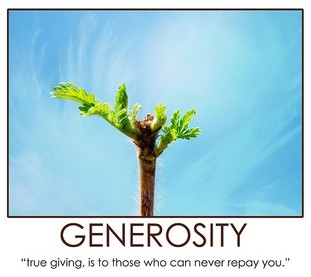
Generosity and Grace

25 Saturday Aug 2012

Posted by mark lloyd richardson in Reflections, Sermon portions

≈ 13 Comments

Tags

Apostle Paul, Christ, Christian life, Divine grace, generosity, Giving, God, Second Corinthians

A monk was out walking one day and saw something shiny on the ground. He bent down to pick it up and found that it was a very valuable, precious gem. So he cleaned it off, put it into his bag, and continued on his way.

A little further along, he met up with a man who asked him if he could spare something to eat. The monk said “Sure” and he opened his bag to get something out. When he did, the man looked inside and saw the gem. He asked the monk, “Could I have that?” and the monk said “Certainly.” The man took the gem and went on his way.

Later the man came back to the monk and returned the gem to him. The monk was very puzzled and asked him why he was giving it back. And here’s what the man said to him: “What I want is whatever it is that allowed you to so easily part with such a valuable gem, because that is what is most precious.”

The Christian life begins in grace and grows in grace and reaches its final rest in grace. This life, when we have eyes to see and ears to hear, is pure grace. It is God’s gift to each of us, and we do not know how long it will be.

The apostle Paul speaks of grace as God’s generosity to us and our generosity with one another. The basis for all of this is our relationship with Christ. Paul states it beautifully when he writes, “For you know the generous act of our Lord Jesus Christ, that though he was rich, yet for your sakes he became poor, so that by his poverty you might become rich” (2 Cor. 8:9).

This is a powerful Christian affirmation. As we hear the words of Paul we become aware again of what has drawn us to this Christian journey – that Christ has done something for us, indeed he’s done something in us, and we can’t see the world the same anymore.

We can’t turn a blind eye to the suffering in other parts of the world. We can’t pretend that people near to us are without need. We can’t live only for ourselves, because that would deny who we are becoming through Christ.

You and I are called to live generous, grace-filled lives. A generous life is a life that recognizes the poverty in riches, and the riches to be discovered in giving ourselves away. God’s grace, when we truly receive it, inspires us to be gracious to others.

How can there be a limit to our lives when we have been given everything? How can we fail to see the amazing grace that is poured into our lives, bringing us forgiveness, purpose, and peace? How can we not respond with an eagerness to reflect the presence of Christ here and now? “For if the eagerness is there,” Paul writes, “the gift is acceptable according to what one has — not according to what one does not have” (2 Cor. 8:12).

That is all God asks of you and me – not to give until it hurts, but to give until we find our joy overflowing, to give until we experience what grace is all about, to give by sharing Christ’s abundance in a world that tends to see only what is lacking.

Words (c) 2012 Mark Lloyd Richardson

Becoming People after God’s Own Heart

27 Friday Jul 2012

Posted by mark lloyd richardson in Reflections, Sermon portions

≈ 14 Comments

Tags

Bible, Christ, Christian faith, Epistle to the Ephesians, new humanity, peace, reconciliation, walls of separation, wide mercy

Christians are known as “people of the Book,” people whose lives are shaped by the Word that God communicates to us through Scripture. We look to the Bible to tell not just any story, but OUR story. In the Bible, we connect with people who struggle to be faithful, people who rely as we do upon the mercies of God.

Mortimer Adler has said, “In the case of good books, the point is not to see how many you can get through, but rather how many can get through to you.” So the true test of how honestly, faithfully, and seriously you are reading the Bible is how much of it is getting through to you!

Two powerful cultural influences create problems for us as we read and respond to the Bible. One is the myth of productivity, which says we are what we do. The second is the myth of consumption, where our perceived worth is measured by our possessions.

The world will not be changed by how hard we work or how many things we own. Our discipleship will not be more fruitful based on what we produce or consume. Our worth is tied up entirely in what Christ has done for all people – breaking down the dividing walls that separate us from one another, the walls we place between ourselves and God, the walls of greed and pride in our hearts, the walls constructed of hatred, injustice, and fear.

United Methodist Bishop Elaine Stanovsky tells a story about one of her three sons, a freshman in college, who returned to his dorm room one evening to find one of his roommates drinking and despondent. As her son talked to him, he discovered that this roommate was gay, and he was a long way from home. That day he had received word that a good friend from high school had committed suicide. He was closeted and had no support system.

Her son didn’t know what to do, but he turned to his roommate, and he said, “Do you go to church?” And the boy said, “Well, I did, but my pastor at home was pretty condemning, and so I really haven’t gone, and I don’t have a church here.”

Her son said, “I attend Epworth Church, just across campus. It’s a reconciling congregation. You could come.”

What he didn’t say to his despondent roommate that night was, “Homosexuality is incompatible with Christian teaching.”

Then Bishop Stanovsky added, “We are so grateful that our son had a church that he could invite his friend to. I am so glad that he grew up in the wideness of God’s mercy” [Vimeo posted on Facebook, July 20, 2012].

The writer of Ephesians reminds us, “Christ is our peace.” Christ came to reconcile all things, things on earth, and things in heaven, so that God would be all in all. In spite of our inclinations to divide ourselves up along party lines, religious denominations, or economic status, Christ enables us to see one another for the sisters and brothers that we are. In spite of our disagreements and the trouble we have living with difference, Christ challenges us to forgive, to strive for mutual understanding, and to be gracious toward one another.

It is up to us to take care not to build or maintain walls of separation between ourselves and others. It is up to us to examine our hearts to find those invisible but very real barriers that can so easily be erected in our lives. In a world that constantly encourages the “us versus them” mentality, the Christian message is that there is no “them.” There is only “us” – all of us, right here in the same boat, members of the same human family. Christ has created in himself “one new humanity in place of the two, thus making peace” (Eph. 2:15b).

Christ does this work of reconciliation for us, among us, and within us. Still, it is up to us to develop within ourselves a spirit of cooperation with the Spirit of Christ. In so doing we are becoming people after God’s own heart.

Give me a pure heart — that I may see Thee,
A humble heart — that I may hear Thee,
A heart of love — that I may serve Thee,
A heart of faith — that I may abide in Thee.
~ Dag Hammarskjold, Markings, 1964

Words (c) 2012 Mark Lloyd Richardson
Photo (c) 2012 Dallis Day Richardson

Made Perfect in Weakness

14 Saturday Jul 2012

Posted by mark lloyd richardson in Reflections, Sermon portions

≈ 15 Comments

Tags

2nd Corinthians, Apostle Paul, grace, John Wesley, Methodists, sanctification, spiritual growth, Stephen Hawking, vulnerability, weakness

Photo by Jeremy Keith, Flickr Creative Commons, Feb. 20, 2006

On a mission trip to Mexico, a coworker named Louise was so impressed with my skills on the compound miter saw that she began to tell everyone she thought I was “perfect.” According to her, I made no mistakes. If that were true, I’m not sure why some of the pieces were returned to me to have small portions shaved off … but let’s not go there! In any event, it was a joke among some of the adults on the crew, with Louise commenting on my perfection, me giving mild protest, and then finally asking her if she would please put it in writing. I thought it might come in handy someday.

We, the people called Methodists, embrace the theology of John Wesley, which speaks of the Christian life as a movement of growth in holiness. Wesley said that from the moment of baptism, the Spirit of God works in a person’s life so that they are able to go on to perfection – that is, they are able, by God’s grace, to grow in love and faith all their days.

Perfection is not a destination likely to be reached in this lifetime, but rather a goal toward which to aim in one’s faith. It is the process of sanctification that Wesley believed occurs within all followers of Christ when they practice the means of grace.

In Second Corinthians 12:2-10, the apostle Paul speaks with a touch of irony about weakness, and specifically of an affliction with which he lived, “a thorn in the flesh.” But our weaknesses are not the end of the story. Our vulnerabilities, our suffering, our pain – God can use and transform even these. Indeed, Paul’s thorn in the flesh helped him rely all the more on God’s grace.

Internationally known astrophysicist Stephen Hawking has been confined to a wheelchair for years due to Lou Gehrig’s disease. He once said that before he became ill life seemed “a pointless existence.” He claims to have been happier after he was afflicted than before. “When one’s expectations are reduced to zero,” he said, “one really appreciates everything that one does have.”

There are few certainties in life. We make plans, and inevitably they change. We expect to remain healthy, only to have our bodies betray us. We hope to have good relationships, and then something happens to create separation or alienation.

All we know for sure, as people of faith, is that God’s strength helps us in our weakness. The God whom we know in Jesus Christ is a suffering God, a vulnerable God, a crucified God, and we can be thankful, ultimately a triumphant God.

Not once, but three times, Paul says he appealed to God to remove the “thorn in his flesh,” and it wasn’t removed. Paul, like us, wants more control over his own wellbeing. Paul, like us, wants some sign that God answers prayers. Paul, like us, doesn’t particularly like feeling vulnerable or weak.

During the Civil War, a hastily written prayer was found in the pocket of a fatally wounded soldier. “I received nothing that I asked for,” it read, “but all I had hoped. My prayers were answered.”

Our prayers are answered in God’s own way. The answer Paul received from God is found in these words of assurance: “My grace is sufficient for you, for power is made perfect in weakness.”

It reminds me of something Alice Abrams said: “In life as in dance: Grace glides on blistered feet.”

So you and I needn’t worry about our imperfections. God specializes in making strong the weak. God specializes in making healthy the sick. God specializes in making rich the poor. Not in the ways we might expect, but true all the same.

We worship a God who in Christ embraces the world and becomes vulnerable to suffering and death … a God who invites us to open ourselves to both pain and wonder.

For it is in our vulnerability that we share in the glory of God whose power is made perfect in weakness.

Words (c) 2012 Mark Lloyd Richardson

When the Storms of Life are Raging

25 Monday Jun 2012

Posted by mark lloyd richardson in Reflections, Sermon portions

≈ 18 Comments

Tags

Christ, faith, God's presence, Gospel of Mark, peace, Sea of Galilee, spirituality, Stand by Me, storms of life

The geography of the Sea of Galilee – a low-lying area surrounded by hills – makes it especially susceptible to sudden and sometimes violent storms. Lake storms can be swift and terrifying, even to those who make their living on them, like the fishermen in Mark 4:35-41.

There are storms in life as well – storms of weakened health or prolonged illness, storms of job loss or mounting debt, storms of troubling global events, storms of emotional upheaval, storms created by the normal aging process, the human journey toward death or the grief of losing someone we love. Most of these storms are uninvited. They appear suddenly on the horizon, like dark gathering clouds, and move toward us while we consider what to do.

The story in Mark’s gospel gets interesting, because Jesus falls asleep on the trip over. This may not seem like a big deal. After all, he’s the carpenter, the rabbi, the landlubber. Some of his disciples have spent their whole lives fishing on this very lake. They are the experienced ones here. They are the ones who understand the variations in weather, and know how to handle them.

But here’s what happens. A great windstorm arises, and the waves beat into the boat, so that the boat is being swamped. The disciples do their best to remove the water, but it is getting into the boat faster than they can bail it out. They panic. These men who have always been comfortable on the water are now having their confidence tested.

Isn’t that how life treats us sometimes? Don’t we have our comfort zones, our places of safety, our circles of family and friends? Don’t we have our country – where the ideals of democracy and freedom have guided us for over two hundred years? And then something happens – a storm brews, divisions arise, an enemy approaches – and we are suddenly in fear for our lives.

In the midst of the raging storm on the Sea of Galilee, the seaworthy disciples find themselves afraid that this might be the day that their time runs out.

They are at the moment of truth.

Life is about to overwhelm them.

Death, they fear, is about to swallow them up.

And Jesus is asleep.

Pastor Kevin McHarg poses this question for us to consider: Am I willing to trust a sleeping Jesus?

When I’m in the doctor’s office awaiting a diagnosis, am I willing to trust a sleeping Jesus?

When I’m in the throes of a difficult divorce, am I willing to trust a sleeping Jesus?

When I’m making a change in my career path, am I willing to trust a sleeping Jesus?

A Jesus on the road to Jerusalem I might be able to trust.

A Jesus opening the eyes of the blind I might be able to trust.

A Jesus teaching on a hillside or in the synagogue I might be able to trust.

But – a sleeping Jesus? I’m not so sure.

The disciples, fearing for their lives, wake Jesus from his sleep, and say to him, “Teacher! The boat’s going down. Don’t you care?”

Jesus wakes up, rebukes the wind, and says to the sea, “Peace! Be still!”

All becomes calm. The wind stops howling. The water lays so still that it reflects the starlight. There is nothing but silence, until Jesus speaks, and asks the question that is asked of us as well, “Why are you afraid? Have you still no faith?”

It is as though Jesus is saying, “I am right here in the boat. I am right here in the midst of your lives. What more do you need before you will trust me?”

Charles Tindley wrote a hymn a century ago titled “Stand By Me.” The opening stanza reads: “When the storms of life are raging, stand by me; … When the world is tossing me, like a ship upon the sea, thou who rulest wind and water, stand by me.”

Faith, you see, is a willingness to let God be God. Faith means that even in the storms of life we know that Christ stands with us. Faith assures us that we are never more than a whispered prayer away from the powerful Presence whom even the storms obey!

Words (c) 2012 Mark Lloyd Richardson
Photo (c) 2012 Dallis Day Richardson

Looking Up When Life Has Got You Down

12 Tuesday Jun 2012

Posted by mark lloyd richardson in Reflections, Sermon portions

≈ 12 Comments

Tags

2 Corinthians, Anne Sullivan, God's reigning, Helen Keller, hope, inner nature, promise, spiritual renewal

Helen Keller once said, “By faith, I mean a vision of good one cherishes and enthusiasm that pushes one to seek its fulfillment, regardless of obstacles. … Faith reinvigorates the will, enriches the affections, and awakens a sense of creativeness. Active faith knows no fear, and it is a safeguard to me against cynicism and despair” [Helen Keller, “The Light of a Brighter Day,” in This I Believe: The Personal Philosophies of Remarkable Men and Women, eds. Jay Allison and Dan Gediman (New York: Henry Holt and Company, 2007), p. 138].

As an infant, a fever left Helen deaf and blind. But with the assistance of her teacher, Anne Sullivan, she learned to communicate through the eyes and ears of others. In time, she graduated from Radcliffe College, and became a renowned author and activist.

Faith is a verb! When we lose ourselves in service to others, it is an expression of faith and a form of participation in the Way of Jesus. As C. S. Lewis once said, “Relying on God has to begin all over again every day as if nothing had yet been done.”

Helen Keller admits how troubled her heart was when she learned of all those who “must labor all their days for food and shelter, bear the most crushing burdens, and die without having known the joy of living.” Likewise, you and I know people who struggle to get by in this economy, who battle addictions, who experience lingering illness, or who do not have a place to call home. We too are affected by the world’s pain because of our shared humanity.

However, it does little good to lose heart. The apostle Paul writes, “So we do not lose heart. Even though our outer nature is wasting away, our inner nature is being renewed day by day” (2 Cor. 4:16). The external material of life as we know it deteriorates and changes. But there is something more than this outer nature we see. There is an inner nature that is being renewed by Christ each and every day!

As disciples of the resurrected Christ, we already live in the dawning of God’s coming reign. We “look not at what can be seen but at what cannot be seen; for what can be seen is temporary, but what cannot be seen is eternal” (4:18).

We do not lose heart because we don’t think this physical, material world is all there is. There is an eternal weight of glory beyond all measure (4:17) waiting for us! We trust that in the age to come both our bodies and the body of Christ will be transformed.

So when life gets us down, we look up! We look at the promise of hope in the risen Christ! We look beyond the transiency of earthly life to the eternal presence of God! We look past the slight momentary afflictions we suffer to the eternal weight of glory seen from the perspective of faith!

Despite her handicaps, Helen Keller was not only grateful; she devoted her life to assisting others who were deaf and blind. She said, “For three things I thank God every day of my life. Thanks that He has given me knowledge of His works; deep thanks that He has set in my darkness the lamp of faith; deep deepest thanks that I have another life to look forward to – a life joyous with light and flowers and heavenly song.”

Rachel Hackenberg, a United Church of Christ pastor in Lancaster, Pennsylvania, has written a beautiful poem called “Hold On.” Here’s an excerpt, but the whole poem is found at faithandwater.blogspot.com.

When all else fails you, hold on to a song:
one that stirs your soul and pulls you with it
on a high soaring ride….

If it is love that fails you, as love does,
hold on to a flower: see how its true beauty
is revealed in blessing the work of bees.

If it is the mind that fails you,
hold on to a toddler’s hand
and discover the world again….

If it is time that fails you, hold on to your path:
you have only the Where and the When
of the Present; God meets you there.

But again, dear friends: when all else fails you,
hold on to a song that sings you to heaven
and do not be afraid.

Words (c) 2012 Mark Lloyd Richardson
Photo (c) 2012 Dallis Day Richardson

← Older posts
Newer posts →
January 2026
S M T W T F S
 123
45678910
11121314151617
18192021222324
25262728293031
« Oct    

Recent Posts

  • A Familiar Peace
  • At Day’s End
  • How Grace Comes
  • A Blessing for Immigrants
  • Now the Work of Christmas Begins

Enter your email address to follow this blog and receive notifications of new posts by email.

Join 356 other subscribers

Archives

  • October 2025
  • August 2025
  • July 2025
  • June 2025
  • December 2024
  • August 2024
  • June 2024
  • May 2024
  • April 2024
  • July 2023
  • August 2022
  • May 2022
  • September 2021
  • August 2021
  • July 2021
  • June 2021
  • April 2021
  • March 2021
  • February 2021
  • March 2020
  • December 2019
  • September 2019
  • August 2019
  • May 2019
  • February 2019
  • October 2018
  • August 2018
  • June 2018
  • May 2018
  • April 2018
  • February 2018
  • October 2017
  • August 2017
  • July 2017
  • May 2017
  • April 2017
  • December 2016
  • November 2016
  • May 2016
  • April 2016
  • March 2016
  • February 2016
  • January 2016
  • December 2015
  • November 2015
  • October 2015
  • September 2015
  • August 2015
  • July 2015
  • May 2015
  • February 2015
  • January 2015
  • December 2014
  • November 2014
  • October 2014
  • September 2014
  • August 2014
  • July 2014
  • June 2014
  • May 2014
  • March 2014
  • February 2014
  • January 2014
  • December 2013
  • November 2013
  • October 2013
  • September 2013
  • August 2013
  • July 2013
  • June 2013
  • May 2013
  • April 2013
  • March 2013
  • February 2013
  • January 2013
  • December 2012
  • November 2012
  • October 2012
  • September 2012
  • August 2012
  • July 2012
  • June 2012
  • May 2012
  • April 2012
  • March 2012
  • February 2012
  • January 2012

Categories

  • Blessings
  • Centering Prayer
  • Contemplative Life
  • Dogs
  • grief
  • Guest Blogs
  • Justice
  • LGBTQ
  • pastoral integrity
  • Peace with justice
  • Poems
  • Prayers
  • Reflections
  • Running
  • Sermon portions
  • Uncategorized
  • Worship Liturgy

Blog Stats

  • 58,974 hits

Meta

  • Create account
  • Log in
  • Entries feed
  • Comments feed
  • WordPress.com

Sacred Pauses

aprilyamasaki.com

Blog at WordPress.com.

  • Subscribe Subscribed
    • dreamprayact
    • Join 356 other subscribers
    • Already have a WordPress.com account? Log in now.
    • dreamprayact
    • Subscribe Subscribed
    • Sign up
    • Log in
    • Report this content
    • View site in Reader
    • Manage subscriptions
    • Collapse this bar
 

Loading Comments...