This poem came to me, I believe, as a kind of counterbalance to the necessary activism of this moment in our country’s history. Each of us needs to take any actions we can to help thwart the encroaching authoritarianism of the Trump administration and to reclaim this country that we love. As a person of faith, I also rest in the knowledge that there is a Divine intention within all of creation, and that a part of my calling as a human being is to cooperate with what the Spirit is already doing in the world. There is a certain peace that comes in remembering that I am one among many who are doing this work of repairing the world, and that each of us brings our gifts to offer to the One who is Lord of all Creation.
A Familiar Peace
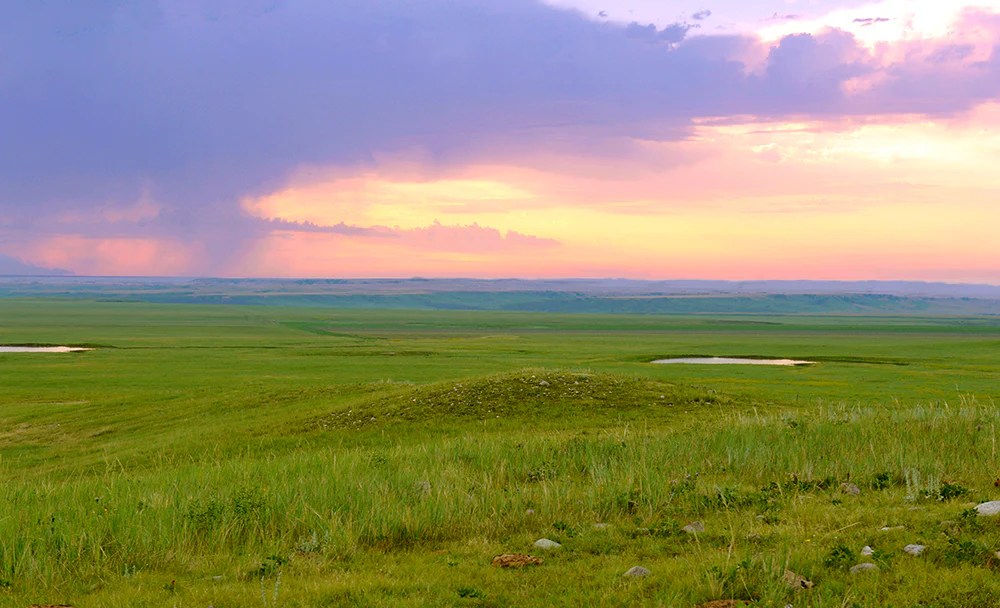
A light mist lingers over the prairie, releasing the purest scent of fall – a fragrant offering spreading gently over the wild greening fields.
This land holds a familiar peace, nestled among these forested hills, as pillowy clouds in shades of gray drift unhurried across the noiseless sky.
No threat of storm, no approaching calamity,
only the quiet calm of morning, the silence nearly audible,
an invitation to breathe.
What blessing rests here in the early hours of this day
to believe that all will be well, in the fullness of time,
(Interestingly, with the exception of indigenous native people, we all belong to one of the many streams of immigrants to this land)
We have in recent days witnessed the brutal tactics of ICE agents as they terrorize immigrants in the midst of normal daily activities, often detaining and removing them from their families in broad daylight. As I thought about the fear and confusion brought on by this state of affairs, I was moved to remind us of the sacred place the scriptures give to the stranger, the alien, the foreigner in our midst:
“Do not mistreat or oppress a foreigner, for you were once a foreigner in a strange land.” ~ Exodus 22:21
“The foreigner residing among you must be treated as your native-born. Love them as yourself, for you were foreigners in Egypt. I am the Lord your God.” ~ Leviticus 19:34
“For I was hungry, and you gave me food. I was thirsty, and you gave me drink. I was a stranger, and you welcomed me.” ~ Matthew 25:35
Then I penned the following blessing for my immigrant neighbors:
Bless the immigrants who play by the rules, who want only to provide for their families, who work hard in jobs most of us are not willing to do, who pay taxes, who contribute to the strength of our communities, who give love and laughter to their families and friends, who seek only to live in peace.
Bless the immigrants who fear daily for their safety, who become scapegoats for larger societal issues, who suffer the abuse of malignant policies and leaders, who must constantly look over their shoulders, who are the objects of continual ridicule, who are gravely misunderstood and maligned, who deserve our gratitude yet too often are met only with hostility.
Bless the immigrants, dear God, and protect them from the dangers and threats of this world.
Bless them and keep them, our sisters and brothers from other lands, languages, and cultures, that together with them we may experience life, liberty, and the pursuit of happiness, and together with them we may create the beloved community where all of God’s children are welcomed, in this place we all lovingly and gratefully call home.
A few weeks ago, I had the privilege of traveling back to Santa Barbara and presenting some reflections on Christmas to an ecumenical Christian group. The title of my presentation was:
The Word Becomes Flesh: Christmas as a Holy Invitation to Incarnational Living
It’s always good to begin with a story, so here’s one that’s been around:
Excited about Christmas, a little boy was finishing a letter to Santa with a list of the Christmas presents he badly wanted. And then, just to make sure he had covered all of his bases, he decided to send his Christmas wish list to Jesus as well. The letter to Jesus began, “Dear Jesus, I just want you to know that I’ve been good for six months now.” Then it occurred to him that Jesus knew this wasn’t true.
After a moment’s reflection, he crossed out “six months” and wrote “three months.” He thought some more, then crossed out “months” and replaced it with “weeks.” “I’ve been good for three weeks,” his letter now read. Realizing Jesus knew better than this, he put down his paper, went over to the Nativity set sitting on a table in his home, and picked up the figure of Mary. He then took out a clean piece of paper and began to write another letter: “Dear Jesus, if you ever want to see your mother again …”[i]
The Word Becomes Flesh: Christmas as a Holy Invitation to Incarnational Living
I titled my presentation before I really knew what I would say – I only knew that I wanted to reflect on what Christmas means to me. I’ve always thought of Christmas as an invitation – an invitation to more fully understand God’s deepest dreams for our lives and our world, that we might become more fully human and reflect the divine image within us, embracing just how unconditionally loved and accepted we are. Jesus is the exemplar of what it means to live a vibrant human life deeply connected to the Source of Life … the Divine Center!
Christmas is a season of special significance for those of us who follow the Christ of the Gospel. It is a season that brings to fulfillment the promises God made to humankind from the very beginning – that God comes near to us when our hearts are open and attuned to the Divine Presence. In the fullness of time, Jesus came near to us in human flesh and lived among us as the very revelation of God’s love, grace and peace. This Jesus of history becomes for those of us who believe the Christ of faith.
In Matthew’s account of Jesus’ birth, he quotes the prophet Isaiah, saying, “Look, the virgin shall conceive and bear a son, and they shall call him Emmanuel,” which means, “God is with us.” (Matt. 1:23) We use the word Incarnation to describe what we believe God has done – in God’s child Jesus the divine Word “becomes flesh.” It’s like having all the promises of scripture revealed in the clearest possible fashion as God is enfleshed in the Human One, Jesus of Nazareth.
How this happens remains a mystery, and I won’t try to further explain it. Rather I want to spend the next 20 minutes talking about why God would come to us in Jesus and what this incredible gift of Divine Life among us might mean for the ways we choose to live in this world!
As we approach Christmas, I encourage you to see this season as a holy invitation to incarnational living! As you contemplate the mystery of Emmanuel, “God with us,” in the days ahead, I hope you will begin to more fully celebrate all the ways you already believe that to be true – where you notice the nudges of the Holy in your life, where you experience God moments, where you glimpse the Sacred amid the ordinary moments of life, and where Grace becomes especially real and transparent to you as you move through each day.
Those of you who know me, know that I include poetry in just about anything I do, since the language of poetry is especially suited to convey mystery.
So, because we are in the season of Advent, we begin with a portion of a poem by Ann Weems, called “In Search of Our Kneeling Places”
In each heart lies a Bethlehem, an inn where we must ultimately answer whether there is room or not. When we are Bethlehem-bound we experience our own advent in his. … This Advent let’s go to Bethlehem and see this thing that the Lord has made known to us. In the midst of shopping sprees let’s ponder in our hearts the Gift of Gifts. … In the excitement and confusion, in the merry chaos, let’s listen for the brush of angels’ wings. This Advent, let’s go to Bethlehem and find our kneeling place.[ii]
We only begin to appreciate the Incarnation when we approach it from a place of awe as we kneel in wonder, prayer, and praise!
The life of a Christian is by definition a life that seeks to follow the Christ, and this act of following begins in adoration. So we need to find our kneeling place each morning as we set out on the journey of faith.
If the birth of the Christ child prompts within us a holy invitation to take up lives that incarnate the love of God, it’s wise to take some time to reflect more fully on how this kind of incarnational living is embodied or comes alive in us.
I want to suggest three possible ways of living incarnationally. They are, of course, not the only ways, just a start!
Incarnational living means recognizing the Divine Presence in all of creation, including you and me.
Richard Rohr – Franciscan priest, author, and teacher – whose work is grounded in practices of contemplation and compassion for the marginalized, writes that “the core message of the incarnation of God in Jesus is that the Divine Presence is here, in us and in all of creation, and not only ‘over there’ in some far-off realm.”[iii]
In 2 Peter 1:4, we read that God “has given us something very great and wonderful … we are able to share the divine nature!” Or, as The Message paraphrases this verse: “We were … given absolutely terrific promises to pass on to you—your tickets to participation in the life of God…”
So, the Divine Presence – the eternal Christ presence – is here in this place, in each one of us, and in all creation. There is a Life at the heart of all life that is holy. There is an essential interrelatedness in all that lives within God’s good creation. We are able to link our lives with the Divine Life. This is an amazing truth to contemplate, because it means that wherever we go the Divine Presence – the eternal Christ presence – is already there, and whatever we do we are potentially participating in the life of God.
I like how one modern-day teacher of Celtic wisdom, John Philip Newell, calls us to practice sacred imagination in our day. He believes that for the sake of our world we need “to truly wake up to the sacredness of the earth and every human being and do what we can to serve this sacredness in one another and the creatures” of this earth. He says we need “a consciousness of soul” to wake up to the sacred interrelationship of all things, “a strength of soul” to commit to live in accordance with this interrelationship, and “a beauty of soul” to be willing to serve this oneness with love, even at the cost of sacrifice.[iv]
So, in saying that incarnational living has to do with recognizing the Divine Presence in all of creation, we are saying that the gift of Christmas is that it invites us to expand our narrow vision of who and where God is. Jesus comes to help us see with compassionate eyes the whole world – a creation deeply and eternally loved by God! Christ is present among us to help us see how our lives are lovingly interconnected with all life on this swirling planet we call home!
II. Incarnational living means exercising your capacity for blessing.
You are an instrument of blessing from the very heart of God, for blessing is God’s incarnate love unleashed on the world. Think of Jesus blessing the disciples and commissioning them to go out and bless all they meet, even those who mean them harm (Luke 6:27-31). “Do to others as you would have them do to you,” Jesus commands. “Love your neighbor as yourself.”
Blessing is a commitment to truly seeing others. Has anyone ever said to you that they feel seen by you? Seeing someone as the unique person they are is an essential first step in blessing them.
Blessing literally means “to speak well of someone,”[v] and Jesus instructs us to do so whether that person is a friend, a stranger, or an enemy. Blessing is a way of communicating the amazing grace of God who pours out grace upon grace in our lives! “Life itself is grace,” Frederick Buechner likes to say. It is a “fathomless mystery.”[vi]So we need to listen with care to our own lives and to the lives of others as well.
“Listening is a form of worship,” says poet James Crew, “but you don’t have to kneel / on the floor with folded hands / or mouth the perfect prayer. / Just open the door of yourself / to another, become the space / they step through to show you / who they are. This is holiness: / two people seated together / on the pew of a park bench, / at the altar of a kitchen table. / Even if no one says a word / for a while, receive the silence / until it’s like a language / only the two of you can speak.”[vii]
Blessing is our gift to the world. We bless others by seeing them, by listening to their lives with them, and by giving away some of our own life so that they can experience more life.
Ronald Rolheiser compares the act of blessing to “a blessing grandmother or a blessing grandfather, not suffering but joyful, smiling and beaming with pride at the life and energy of the young, basking in that energy and radiating from every pore of his or her being the words of the Creator: ‘It is good! Indeed, it is very good! In you I take delight!’”[viii]
Still, blessing takes different forms at different times. When someone is grieving a deep loss in life, blessing needs to be filled with compassion. When my wife Dallis died four years ago, the book of blessings for times of grief written by Jan Richardson consoled me. Here’s one of her blessings, written following the death of her husband Gary, that may help you understand better the gift of blessing you have to offer someone as they wade through the troubled waters of grief.
Do not tell me there will be a blessing in the breaking, that it will ever be a grace to wake into this life so altered, this world so without.
Do not tell me of the blessing that will come in the absence.
Do not tell me that what does not kill me will make me strong or that God will not send me more than I can bear.
Do not tell me this will make me more compassionate, more loving, more holy.
Do not tell me this will make me more grateful for what I had.
Do not tell me I was lucky.
Do not even tell me there will be a blessing.
Give me instead the blessing of breathing with me.
Give me instead the blessing of sitting with me when you cannot think of what to say.
Give me instead the blessing of asking about him— how we met or what I loved most about the life we have shared; ask for a story or tell me one because a story is, finally, the only place on earth he lives now.
If you could know what grace lives in such a blessing, you would never cease to offer it.
If you could glimpse the solace and sweetness that abide there, you would never wonder if there was a blessing you could give that would be better than this – the blessing of your own heart opened and beating with mine.
No one escapes loss or grief in this life – it’s part of the human condition. Jesus knows the suffering of the human heart and he chooses to heal, to forgive, to love and to bless everyone he meets. In Jesus – “Emmanuel, God with us” – we see the compassionate heart of God for the world.
Shortly after I retired and moved to Ashland, I joined the spiritual care team at a local residential Hospice house. In our training, we learned that our role as volunteers was to be present, to be kind, and to be honest.Notice the phrasing “to be” rather than “to do.” In the company of those experiencing deep losses, it was important for us to understand our role as those who accompany another on life’s journey through death. These guidelines also seem to me to be a good philosophy for living in relationship with others in the spirit of Christ.
As we read the gospels, so often these are the ways that Jesus meets whoever is before him. He is presentwith them. He sees them exactly as they are, but through eyes of compassion. He is kind. He illumines the loving-kindness of God. And he is honest. He tells the truth without recrimination and only so that the one before him can recognize it and decide what they will do with it.
We who follow Christ have the capacity to bless others as well with our presence, our kindness, and our honesty. We can look upon the world with eyes of compassion for we know we have been recipients of such generous love ourselves. We can see others through the lens of grace for it is only grace that has saved us.
Incarnational living means breathing in the life of God and breathing out blessing for all that God has created and loved.
III. Incarnational living means doing the work of Christmas every day.
Christian preacher and teacher Tony Campolo once said, “Jesus never says to the poor: ‘come find the church’, but he says to those of us in the church: ‘go into the world and find the poor, hungry, homeless, imprisoned.”
Christmas is an invitation to follow Jesus into the world and embody the same kind of compassionate presence that he did. It’s an invitation to befriend the lonely, heal the broken, bless the one wounded by life. Incarnational living means picking up the mantle of Jesus’ ministry and letting it live through you. It is to “let the same mind be in you that was in Christ Jesus,” as we read in Philippians 2:5, and emptying yourself in order to serve those around you.
To mark the day when the Christmas season comes to an end on the feast of Epiphany, Howard Thurman, an African-American theologian, educator, and civil rights leader, wrote this benediction.
When the song of the angels is stilled, when the star in the sky is gone, when the kings and princes are home, when the shepherds are back with their flocks, the work of Christmas begins: to find the lost, to heal the broken, to feed the hungry, to release the prisoner, to rebuild the nations, to bring peace among the people, to make music in the heart.
“Jesus came to incarnate God’s presence and love to humanity. But before he left this earth, he called us to do the same in his name. Jesus’ followers are intended to put flesh on the invisible God, to incarnate God for the world. We know what this looks like because we see incarnation in Jesus as we read the Gospels. (The apostle) Paul … (calls) the church … ‘the body of Christ.’ We are the ongoing incarnation.”[xi]
We who seek to incarnate the unconditional love of God for the world can choose to live as justice-seeking, love-creating, truth-telling, hope-birthing people![xii]Or as biblical theologian Walter Brueggemann states it: “Like the ancient prophets, we are dispatched back to the good work entrusted to us. It is the work of peace-making. It is the work of truth-telling. It is the work of justice-doing. It is good work, but it requires our resolve to stay it, even in the face of forces to the contrary that are sure to prevail for a season.”[xiii]
Christmas is a holy invitation to:
recognize the Divine Presence in all of creation,
exercise your God-given capacity for blessing others, and
continue the good work of Christmas every day.
May we, by the grace of God, more fully embrace incarnational living this Christmas so that our lives are a blessing to others and to the world, showing forth the light and love of Christ!
Mark Lloyd Richardson
[i] Adam Hamilton, Incarnation: Rediscovering the Significance of Christmas (Nashville: Abingdon Press, 2020),pp. 46-7.
[ii] Ann Weems, Kneeling in Bethlehem (Philadelphia, The Westminster Press, 1980), p. 19.
[iii] Richard Rohr, The Universal Christ, p. 29. St. Athanasius (296-373) says that God reveals God’s Self everywhere in creation, “so that nothing was left devoid of his Divinity … so that ‘the whole universe was filled with the knowledge of the Lord as the waters fill the sea.’’” (Athanasius, De Incarnatione Verbi 45).
[iv] John Philip Newell, Sacred Earth Sacred Soul (New York: HarperCollins Publishers, 2021), p. 143.
[v] The English term “to bless” comes from Latin benedicere, literally “to speak well of” (as in bene – meaning well or good, and dicere – meaning to speak). Thus, at its root, to bless someone is to speak well of him or her.
[vi] Frederick Buechner, Listening to your Life: Daily Meditations with Frederick Buechner.
[vii] James Crew, poem “How to Listen,” San Luis Obispo County Arts Council email.
[viii] Ronald Rolheiser, Sacred Fire: A Vision for a Deeper Human and Christian Maturity (New York: Image, 2014), p. 242.
[ix] Jan Richardson, The Cure for Sorrows: A Book of Blessings for Times of Grief (Orlando, FL: Wanton Gospeller Press, 2016),pp. 53-4.
[x]The poem “The Work of Christmas” is from Howard Thurman’s The Mood of Christmas and Other Celebrations and is used by permission of Friends United Press. All rights reserved.
“Life is a gift. But it is a gift shrouded in pain.” ~ Noel O’Donoghue
To walk in this world, to receive the gifts of earth and sea and sky, to hear the breath of our origins in the wind, to step upon the land of our ancestors, to greet creatures great and small in wonder, to listen with compassion to the earth’s memory, is to live.
Beauty is all around, in the ancient and the new, in places near and far away, in all paths that seek wholeness and peace, in all hearts that hold space for the other.
Beauty is within each one, beloved and valued by the Eternal Presence, bearing holiness in our intricately made bodies, birthing gentleness among the weary.
We carry sorrow too though. It is our companion through this life. The brokenness around us cannot be ignored. Neither can the brokenness within.
The pain of the inhumane. The pain of the neglected. The pain of the victims of violence. The pain of the discarded and unworthy.
The pain of injustice. The pain of separation. The pain of exclusion. The pain of indifference.
Suffering is all around, in the long ago and the near at hand, in places we know and those just beyond our reach, in all paths that sow division and fear, in all hearts that close themselves off.
Suffering is within each one, in the feeling of being lost or forsaken, removed from the deep love we once knew, in the harshness of life on the edge.
Yet may our love of life not be diminished.
Bless the suffering ones, O Lord, bind the wounded ones, bring peace to places of discord, encourage the despairing, gladden the hearts of the grieving, lend your light to all our paths.
Bless and protect the sacred gifts of life that flow in and among us, that all of us and indeed all of creation may one day worship at the altar where heaven and earth meet and all injury may be pardoned and all suffering be relieved and all brokenness be mended and all tears be wiped away.
New York City 20th Anniversary of 9/11 Weekend Memorial
A Prayer for Our Country On the eve of the twentieth anniversary of 9/11
“For Jesus, there are no countries to be conquered, no ideologies to be imposed, no people to be dominated. There are only children, women and men to be loved.” ~ Henri Nouwen
God of expansive and generous love, whose concern is the whole wide wonderful world, especially the vulnerable and anawim (poor ones), who hears prayers in countless languages, who cannot be imprisoned in any one religion, who took human form in a person of color, in whom unity is discovered in beautiful diversity, whose heart breaks anew each day at the disease, death, and destruction wrought by the creatures of earth, hear our prayer.
We cannot claim you as our own – you are not an American God. To do so is blasphemy.
Rather, you claim us as your own – ordinary folks from all walks of life, each one different, yet more similar than dissimilar – and you call us to live lives of genuine love, caring for the least of these among us, becoming persistent warriors for peace, laboring to achieve justice for all, seeking to be compassionate as God is compassionate.
So, while we identified some enemies and misidentified others in the aftermath of 9/11, and then marched dutifully off to war, thinking we could avenge the harm done to us when the World Trade Center and the Pentagon were struck and a plane was forced down in a Pennsylvania field, and so many innocent lives of loved ones with futures and hopes were lost to us, we were mostly serving ourselves, not you.
We pray for our country on this anniversary of tragedy and resolve. We pray for comfort in our collective grief.
We pray too that the discipline of duty might be turned to addressing our own troubles before turning our fury upon others.
We pray that we begin to take seriously matters of liberty and justice that affect us all, directly or indirectly – climate change, income inequality, equal access to voting, racial profiling, police violence, wrongful convictions, prisons built upon profits, women’s health and reproductive choices, equal protections for our LGBTQ siblings.
We pray for healing amid our deep divisions, not so that we all think alike, but so that we might again be able to talk meaningfully and honestly with one another.
Finally, we pray for the wisdom to reclaim and redefine our nation’s core principles to ensure the liberty and justice that is due to all.
Dallis & I on the Big Island November 2014 (Photo: Wendy Granger)
My dear Dallis,
Sweetheart, I know I told you as you were dying that everything would be okay … that I would be okay … but it was a lie. I don’t like lying to you and I didn’t intend to do so; I was just trying to convince myself, and I was telling you what I thought you needed to hear so that you could let go and be released from a body that was failing you. But now I am utterly heartbroken. I feel completely lost without you. I want so badly to hear your voice again. I want to kiss your lips. I want to hold you and be held by you.
What touched my life so thoroughly during our love affair and marriage is how you would look at me with such affection in your eyes it melted my heart. You brought me to tears so many times just by being honest with me about how you felt. We told each other our deepest truths. We relied on one another to always care most about the other.
I can’t believe how lucky I was to have you in my life for nineteen years. If I had known sooner that our time together was nearing the end, I would have stopped working earlier and devoted all my time to you … to us! I would have reveled all the more in your smile and laugh. I would have asked you to tell me more about the greatest joys of your life, all the way back. I would have wanted to watch your New Zealand slides with you, and have you regale me about that favorite adventure of yours, years before we met.
I would also have wanted to hear more about the places of pain and disappointment in your life, many of which I know about and others I imagine were left unsaid.
This grief hurts beyond imagining. I feel like I’m dying inside. I struggle just to do the simplest things and get through each day.
I wish there was a way to communicate with you, my beloved. I write these thoughts I’ve been thinking and wish I could get this message to you. You were the very one I needed in my life. You cheered my successes, savored our relationship, and gave me every bit of yourself to love and enjoy. You were my anchor, my safe haven, my source of lightheartedness and joy.
I’m trying to figure out how to live without you near to me, your physical presence that is. I have never been through more painful days than these. A heavy sadness follows me everywhere, even to sleep. Nothing in my life experience compares to this aching I feel in body, mind and spirit.
Dallis, my beautiful one, it is my deepest hope that you are where there is no more pain and no more crying, and where you know deep and abiding peace. I also hope to see you often in my dreams.
We used this communion liturgy I wrote in worship this morning, playing off of the words and music of the lovely communion song by Barbara Hamm titled “Come to the Table of Grace,” found in the songbook Worship & Song. Please feel free to use in your worship context if you find it meaningful.
Liturgy for Holy Communion
(Singing #3168 “Come to the Table of Grace”)
This is God’s table.
Here we are invited to taste grace,
the grace that lightens the human heart
and widens the human soul
by creating an opening for God to enter –
the God who brings healing to bodies, minds, and spirits,
the God who meets us in the deep center of life itself
where we discover truth that sets us free.
This is a feast of grace
for the saint and sinner in each one of us.
Let us come to the table of grace.
Sing verse 1: “Come to the table of grace.”
When we gather at the table of our Lord
it is an invitation to live in peace with our neighbors.
The Prince of peace comes among us
and extends a word of peace –
peace for our troubled hearts,
peace for our troubled relationships,
peace for our troubled neighborhoods,
peace for our troubled environment,
peace for our troubled global community.
In Christ we are empowered to lay down our swords,
whether they be cutting words or violent actions,
whether they be divisive symbols or self-justifications,
and yield ourselves to the Savior
who comes with peace on his lips,
peace in his very presence.
Let us come to the table of peace.
Sing verse 2: “Come to the table of peace.”
When Jesus met with his friends
on the night he was betrayed and arrested,
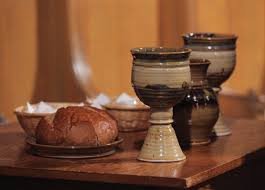
he took the bread that sustains life,
and he blessed and broke it before them.
He took the common cup filled with wine
and he claimed that these ordinary parts of their meal
were in truth sacred reminders of the gifts of God.
The bread reminded them of the manna
their ancestors received to ease their hunger in the wilderness.
The cup reminded them of the miracle of new wine
at a Cana wedding and at the heavenly feast to come.
Together these ordinary signs tell the story of God’s love
being expressed to all generations.
They show how Jesus himself modeled divine love
as he welcomed the outcast, forgave the sinner,
healed the sick, showed compassion for the hungry,
and called a child to come sit on his lap and be blessed.
Now it is for us to live the way of love of Jesus,
to love outside of our comfort zones, our arbitrary walls,
to love extravagantly as though it can’t run out.
Let us come to the table of love.
Sing verse 3: “Come to the table of love.”
God who sets this bountiful table before us,
a table of grace and peace,
a table of love and joy,
pour out your Holy Spirit upon us
and upon these gifts of bread and wine,
that through Christ’s presence here
we may become a people of grace,
a source of joy, a witness to love,
and instruments of your peace.
By your Holy Spirit,
make us one with Christ,
one with each other,
one with all who walk in your light,
and one in ministry to the whole world, no exceptions,
until we feast at the heavenly banquet.
Let us come to the table of joy.
Photograph “Blistery blustery beautiful day” by Dallis Day Richardson
God,
I want to see you
in each person I meet today
in each conversation I have with another
in each joy discovered
in each suffering shared.
I want to know
in my inmost being
the humanity of Jesus
whose constant prayer was
to be intimately connected with you
in the doing of justice
the enactment of peace
the power of sacrificial love.
I want to seek
friendship with the divine
more than right beliefs
dutiful virtues
or accepted behaviors
so that the movement of my soul
might be toward life in its fullness
life in touch with the Center
life contributing to newness
life in communion with others
life as holy gift
life as sheer wonder.
May I embody
what to me is true
what to me is beautiful
what to me is eternal –
a life whose wholeness is found in God,
a song that can only be sung
in concert with all of creation!
God who watches over our world,
who companions us along life’s way,
who breathes life into our lives,
we come to lift our praise-filled voices,
to utter our heart’s trembling cries,
to be still, and to know,
to be struck again by the audacity of divine love.
Jesus, Lamb of God,
the one in whom we see love most freely given,
the one who is Rabbi, healer, and friend,
this Jesus invites us to open our eyes
and look with compassion on the needs of the world –
needs for basic necessities of food and shelter,
adequate health care and clean water,
needs for spiritual nourishment and hope,
a cup of life-restoring water,
needs for community and solidarity,
bridging differences with other children of God.
Jesus, the Christ of love’s kingdom,
in whom broken places are mended
and neighbors find common cause healing the world,
this Jesus invites us to open our ears
and hear the summons to follow –
following the Master’s voice,
becoming people brimming with holy grace,
following to places where our comforts are put aside
by the one who disturbs the status quo,
following the call to reshape the world around us
by going where Christ’s love and footsteps show.
Spirit of love, holy wind, breath of life,
replenish our spirits and claim us anew.
Grant us the strength we need
to break down walls of injustice,
to speak up for those on the margins,
to stand with all who are suffering,
to follow all the way to the cross, no turning back.
Spirit of truth, holy word of life,
charge us with a mission of mercy,
a partnership of peace,
that we might more fully live
into your vision of wholeness & shalom.
May your Church,
Creator, Christ, and holy wind,
be faithful in service,
courageous in witness,
steady in fighting injustice,
loyal in our allegiance to the gospel,
savvy in confronting evil,
persistent in walking the path of peace,
and above all,
loving in our actions toward friend and foe.
Bless this earthly home with protection and care.
Bless your people with resurrection power.
Bless decision-makers with a compassionate wisdom,
journalists with the boldness of truth,
and citizens with boundless energy
in the pursuit of the common good.
We pray all of this in the name of Jesus,
who pronounces blessings upon anyone seeking
to align their lives with your kingdom of love. Amen.
Church on Red Bluff Road, south of Quesnel, British Columbia, Photo credit: blog Cruising Canuckistan
Bless the people
who labor for a better life
a better neighborhood
a better country
a better world,
who love family
create community
and give of themselves
so that seeds of hope
planted in places of despair
may be watered
and grow
and emerge as new life!
Bless the artists and poets
who see what might be
with a piercing clarity
of what now is.
Bless the journalists
who ask uncomfortable questions
and expose inconvenient mistruths
in their dogged pursuit of truth.
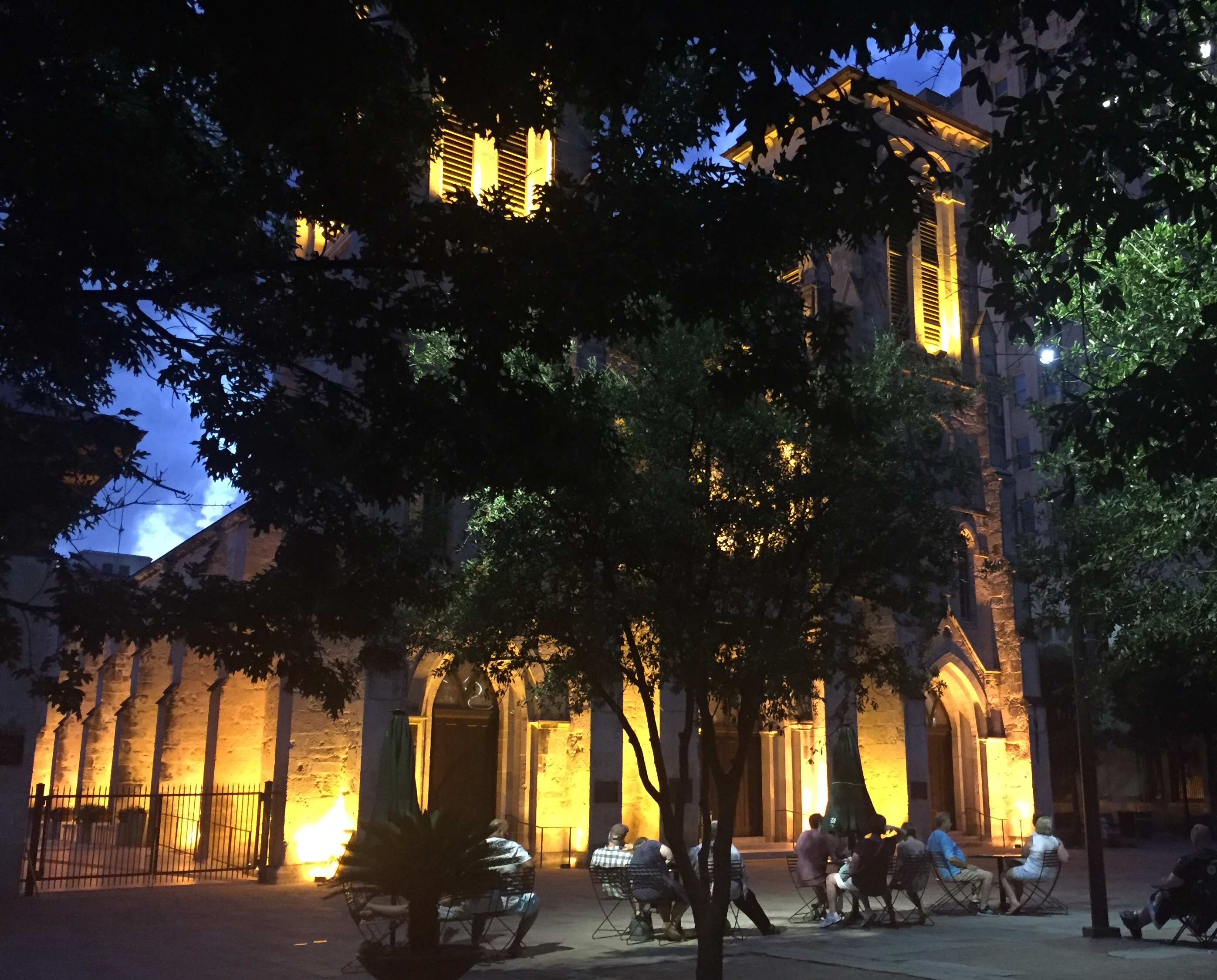
Bless the churches and mosques and synagogues
that dot the prairies, hills and valleys
of this precious landscape,
breathing a spirit of prayer and goodness
into the shared life of their communities.
Bless truck driver, crop picker, waiter and cook.
Bless coal miner, windmill farmer, and solar installer.
Bless single mother, newly married, aging couple, and widowed.
Bless teacher, student, leader, and follower.
Bless dreamer, shaper, thinker, and friend.
Bless the fraying edges of relationships,
the absences and separations,
the losses and heartaches,
the holy disruptions,
the sacred silences of peace.
Bless it all, Creation’s Lord.
Let the sunlight of your grace
shine upon poor and rich alike
exposing the treasures nearest each beating heart –
love of neighbor,
love of God.
Bless the whole world, we pray –
no exceptions.





 God who watches over our world,
 dreamprayact