• About Me
  • Contact
  • What’s in a name?

dreamprayact

~ Reflections of a preacher, poet, and contemplative activist

dreamprayact

Category Archives: Justice

Now the Work of Christmas Begins

31 Tuesday Dec 2024

Posted by mark lloyd richardson in Blessings, Justice, Poems, Reflections

≈ Leave a comment

Tags

Bible, blessing, caring, Christmas, compassion, creation, Divine presence, eternal Christ presence, God, grief, incarnation, Jesus, justice, peace, truth

Frosted blue spruce tree.

A few weeks ago, I had the privilege of traveling back to Santa Barbara and presenting some reflections on Christmas to an ecumenical Christian group. The title of my presentation was:

The Word Becomes Flesh: Christmas as a Holy Invitation to Incarnational Living

     It’s always good to begin with a story, so here’s one that’s been around:

     Excited about Christmas, a little boy was finishing a letter to Santa with a list of the Christmas presents he badly wanted. And then, just to make sure he had covered all of his bases, he decided to send his Christmas wish list to Jesus as well. The letter to Jesus began, “Dear Jesus, I just want you to know that I’ve been good for six months now.” Then it occurred to him that Jesus knew this wasn’t true.

     After a moment’s reflection, he crossed out “six months” and wrote “three months.” He thought some more, then crossed out “months” and replaced it with “weeks.” “I’ve been good for three weeks,” his letter now read. Realizing Jesus knew better than this, he put down his paper, went over to the Nativity set sitting on a table in his home, and picked up the figure of Mary. He then took out a clean piece of paper and began to write another letter: “Dear Jesus, if you ever want to see your mother again …”[i]

     The Word Becomes Flesh: Christmas as a Holy Invitation to Incarnational Living

     I titled my presentation before I really knew what I would say – I only knew that I wanted to reflect on what Christmas means to me. I’ve always thought of Christmas as an invitation – an invitation to more fully understand God’s deepest dreams for our lives and our world, that we might become more fully human and reflect the divine image within us, embracing just how unconditionally loved and accepted we are. Jesus is the exemplar of what it means to live a vibrant human life deeply connected to the Source of Life … the Divine Center! 

     Christmas is a season of special significance for those of us who follow the Christ of the Gospel. It is a season that brings to fulfillment the promises God made to humankind from the very beginning – that God comes near to us when our hearts are open and attuned to the Divine Presence. In the fullness of time, Jesus came near to us in human flesh and lived among us as the very revelation of God’s love, grace and peace. This Jesus of history becomes for those of us who believe the Christ of faith. 

     In Matthew’s account of Jesus’ birth, he quotes the prophet Isaiah, saying, “Look, the virgin shall conceive and bear a son, and they shall call him Emmanuel,” which means, “God is with us.” (Matt. 1:23) We use the word Incarnation to describe what we believe God has done – in God’s child Jesus the divine Word “becomes flesh.” It’s like having all the promises of scripture revealed in the clearest possible fashion as God is enfleshed in the Human One, Jesus of Nazareth.

     How this happens remains a mystery, and I won’t try to further explain it. Rather I want to spend the next 20 minutes talking about why God would come to us in Jesus and what this incredible gift of Divine Life among us might mean for the ways we choose to live in this world!

     As we approach Christmas, I encourage you to see this season as a holy invitation to incarnational living! As you contemplate the mystery of Emmanuel, “God with us,” in the days ahead, I hope you will begin to more fully celebrate all the ways you already believe that to be true – where you notice the nudges of the Holy in your life, where you experience God moments, where you glimpse the Sacred amid the ordinary moments of life, and where Grace becomes especially real and transparent to you as you move through each day. 

     Those of you who know me, know that I include poetry in just about anything I do, since the language of poetry is especially suited to convey mystery.

     So, because we are in the season of Advent, we begin with a portion of a poem by Ann Weems, called “In Search of Our Kneeling Places”

In each heart lies a Bethlehem,
    an inn where we must ultimately answer
         whether there is room or not.
When we are Bethlehem-bound
    we experience our own advent in his. …
This Advent let’s go to Bethlehem
    and see this thing that the Lord has made known to us.
In the midst of shopping sprees
    let’s ponder in our hearts the Gift of Gifts. …
In the excitement and confusion, in the merry chaos,
    let’s listen for the brush of angels’ wings.
This Advent, let’s go to Bethlehem
    and find our kneeling place.[ii]

     We only begin to appreciate the Incarnation when we approach it from a place of awe as we kneel in wonder, prayer, and praise!

     The life of a Christian is by definition a life that seeks to follow the Christ, and this act of following begins in adoration. So we need to find our kneeling place each morning as we set out on the journey of faith.

     If the birth of the Christ child prompts within us a holy invitation to take up lives that incarnate the love of God, it’s wise to take some time to reflect more fully on how this kind of incarnational living is embodied or comes alive in us. 

I want to suggest three possible ways of living incarnationally. They are, of course, not the only ways, just a start!

  1. Incarnational living means recognizing the Divine Presence in all of creation, including you and me.

     Richard Rohr – Franciscan priest, author, and teacher – whose work is grounded in practices of contemplation and compassion for the marginalized, writes that “the core message of the incarnation of God in Jesus is that the Divine Presence is here, in us and in all of creation, and not only ‘over there’ in some far-off realm.”[iii]

     In 2 Peter 1:4, we read that God “has given us something very great and wonderful … we are able to share the divine nature!” Or, as The Message paraphrases this verse: “We were … given absolutely terrific promises to pass on to you—your tickets to participation in the life of God…”

      So, the Divine Presence – the eternal Christ presence – is here in this place, in each one of us, and in all creation. There is a Life at the heart of all life that is holy. There is an essential interrelatedness in all that lives within God’s good creation. We are able to link our lives with the Divine Life. This is an amazing truth to contemplate, because it means that wherever we go the Divine Presence – the eternal Christ presence – is already there, and whatever we do we are potentially participating in the life of God.

      I like how one modern-day teacher of Celtic wisdom, John Philip Newell, calls us to practice sacred imagination in our day. He believes that for the sake of our world we need “to truly wake up to the sacredness of the earth and every human being and do what we can to serve this sacredness in one another and the creatures” of this earth. He says we need “a consciousness of soul” to wake up to the sacred interrelationship of all things, “a strength of soul” to commit to live in accordance with this interrelationship, and “a beauty of soul” to be willing to serve this oneness with love, even at the cost of sacrifice.[iv]

      So, in saying that incarnational living has to do with recognizing the Divine Presence in all of creation, we are saying that the gift of Christmas is that it invites us to expand our narrow vision of who and where God is. Jesus comes to help us see with compassionate eyes the whole world – a creation deeply and eternally loved by God! Christ is present among us to help us see how our lives are lovingly interconnected with all life on this swirling planet we call home!

II. Incarnational living means exercising your capacity for blessing.

         You are an instrument of blessing from the very heart of God, for blessing is God’s incarnate love unleashed on the world. Think of Jesus blessing the disciples and commissioning them to go out and bless all they meet, even those who mean them harm (Luke 6:27-31). “Do to others as you would have them do to you,” Jesus commands. “Love your neighbor as yourself.”

          Blessing is a commitment to truly seeing others. Has anyone ever said to you that they feel seen by you? Seeing someone as the unique person they are is an essential first step in blessing them. 

          Blessing literally means “to speak well of someone,”[v] and Jesus instructs us to do so whether that person is a friend, a stranger, or an enemy. Blessing is a way of communicating the amazing grace of God who pours out grace upon grace in our lives! “Life itself is grace,” Frederick Buechner likes to say. It is a “fathomless mystery.”[vi] So we need to listen with care to our own lives and to the lives of others as well.

          “Listening is a form of worship,” says poet James Crew, “but you don’t have to kneel / on the floor with folded hands / or mouth the perfect prayer. / Just open the door of yourself / to another, become the space / they step through to show you / who they are. This is holiness: / two people seated together / on the pew of a park bench, / at the altar of a kitchen table. / Even if no one says a word / for a while, receive the silence / until it’s like a language / only the two of you can speak.”[vii]

          Blessing is our gift to the world. We bless others by seeing them, by listening to their lives with them, and by giving away some of our own life so that they can experience more life.

          Ronald Rolheiser compares the act of blessing to “a blessing grandmother or a blessing grandfather, not suffering but joyful, smiling and beaming with pride at the life and energy of the young, basking in that energy and radiating from every pore of his or her being the words of the Creator: ‘It is good! Indeed, it is very good! In you I take delight!’”[viii]

          Still, blessing takes different forms at different times. When someone is grieving a deep loss in life, blessing needs to be filled with compassion. When my wife Dallis died four years ago, the book of blessings for times of grief written by Jan Richardson consoled me. Here’s one of her blessings, written following the death of her husband Gary, that may help you understand better the gift of blessing you have to offer someone as they wade through the troubled waters of grief. 

    The Blessing You Should Not Tell Me[ix]

    Do not tell me 
    there will be a blessing
    in the breaking,
    that it will ever
    be a grace
    to wake into this life
    so altered,
    this world
    so without.

    Do not tell me
    of the blessing
    that will come
    in the absence.

    Do not tell me
    that what does not
    kill me
    will make me strong
    or that God will not 
    send me more than I
    can bear.

    Do not tell me
    this will make me
    more compassionate,
    more loving,
    more holy.

    Do not tell me
    this will make me
    more grateful for what
    I had.

    Do not tell me
    I was lucky.

    Do not even tell me
    there will be a blessing.

    Give me instead
    the blessing
    of breathing with me.

    Give me instead
    the blessing
    of sitting with me
    when you cannot think
    of what to say.

    Give me instead
    the blessing
    of asking about him—
    how we met
    or what I loved most
    about the life
    we have shared;
    ask for a story 
    or tell me one
    because a story is, finally,
    the only place on earth
    he lives now.

    If you could know
    what grace lives
    in such a blessing,
    you would never cease
    to offer it.

    If you could glimpse
    the solace and sweetness
    that abide there,
    you would never wonder
    if there was a blessing
    you could give
    that would be better
    than this – 
    the blessing of 
    your own heart
    opened
    and beating
    with mine.

          No one escapes loss or grief in this life – it’s part of the human condition. Jesus knows the suffering of the human heart and he chooses to heal, to forgive, to love and to bless everyone he meets. In Jesus – “Emmanuel, God with us” – we see the compassionate heart of God for the world.

          Shortly after I retired and moved to Ashland, I joined the spiritual care team at a local residential Hospice house. In our training, we learned that our role as volunteers was to be present, to be kind, and to be honest.Notice the phrasing “to be” rather than “to do.” In the company of those experiencing deep losses, it was important for us to understand our role as those who accompany another on life’s journey through death. These guidelines also seem to me to be a good philosophy for living in relationship with others in the spirit of Christ. 

          As we read the gospels, so often these are the ways that Jesus meets whoever is before him. He is presentwith them. He sees them exactly as they are, but through eyes of compassion. He is kind. He illumines the loving-kindness of God. And he is honest. He tells the truth without recrimination and only so that the one before him can recognize it and decide what they will do with it.

          We who follow Christ have the capacity to bless others as well with our presence, our kindness, and our honesty. We can look upon the world with eyes of compassion for we know we have been recipients of such generous love ourselves. We can see others through the lens of grace for it is only grace that has saved us. 

          Incarnational living means breathing in the life of God and breathing out blessing for all that God has created and loved.

    III. Incarnational living means doing the work of Christmas every day.

          Christian preacher and teacher Tony Campolo once said, “Jesus never says to the poor: ‘come find the church’, but he says to those of us in the church: ‘go into the world and find the poor, hungry, homeless, imprisoned.”

          Christmas is an invitation to follow Jesus into the world and embody the same kind of compassionate presence that he did. It’s an invitation to befriend the lonely, heal the broken, bless the one wounded by life. Incarnational living means picking up the mantle of Jesus’ ministry and letting it live through you. It is to “let the same mind be in you that was in Christ Jesus,” as we read in Philippians 2:5, and emptying yourself in order to serve those around you. 

         To mark the day when the Christmas season comes to an end on the feast of Epiphany, Howard Thurman, an African-American theologian, educator, and civil rights leader, wrote this benediction.

    Now the Work of Christmas Begins[x]

    When the song of the angels is stilled,
    when the star in the sky is gone,
    when the kings and princes are home,
    when the shepherds are back with their flocks,
    the work of Christmas begins:
    to find the lost,
    to heal the broken,
    to feed the hungry,
    to release the prisoner,
    to rebuild the nations,
    to bring peace among the people,
    to make music in the heart.

         “Jesus came to incarnate God’s presence and love to humanity. But before he left this earth, he called us to do the same in his name. Jesus’ followers are intended to put flesh on the invisible God, to incarnate God for the world. We know what this looks like because we see incarnation in Jesus as we read the Gospels. (The apostle) Paul … (calls) the church … ‘the body of Christ.’ We are the ongoing incarnation.”[xi]

          We who seek to incarnate the unconditional love of God for the world can choose to live as justice-seeking, love-creating, truth-telling, hope-birthing people![xii] Or as biblical theologian Walter Brueggemann states it: “Like the ancient prophets, we are dispatched back to the good work entrusted to us. It is the work of peace-making. It is the work of truth-telling. It is the work of justice-doing. It is good work, but it requires our resolve to stay it, even in the face of forces to the contrary that are sure to prevail for a season.”[xiii]

          Christmas is a holy invitation to:

    1. recognize the Divine Presence in all of creation,
    2. exercise your God-given capacity for blessing others, and 
    3. continue the good work of Christmas every day.

          May we, by the grace of God, more fully embrace incarnational living this Christmas so that our lives are a blessing to others and to the world, showing forth the light and love of Christ!

    Mark Lloyd Richardson


    [i] Adam Hamilton, Incarnation: Rediscovering the Significance of Christmas (Nashville: Abingdon Press, 2020), pp. 46-7.

    [ii] Ann Weems, Kneeling in Bethlehem (Philadelphia, The Westminster Press, 1980), p. 19.

    [iii] Richard Rohr, The Universal Christ, p. 29. St. Athanasius (296-373) says that God reveals God’s Self everywhere in creation, “so that nothing was left devoid of his Divinity … so that ‘the whole universe was filled with the knowledge of the Lord as the waters fill the sea.’’” (Athanasius, De Incarnatione Verbi 45).

    [iv] John Philip Newell, Sacred Earth Sacred Soul (New York: HarperCollins Publishers, 2021), p. 143.

    [v] The English term “to bless” comes from Latin benedicere, literally “to speak well of” (as in bene – meaning well or good, and dicere – meaning to speak). Thus, at its root, to bless someone is to speak well of him or her.

    [vi] Frederick Buechner, Listening to your Life: Daily Meditations with Frederick Buechner.

    [vii] James Crew, poem “How to Listen,” San Luis Obispo County Arts Council email. 

    [viii] Ronald Rolheiser, Sacred Fire: A Vision for a Deeper Human and Christian Maturity (New York: Image, 2014), p. 242.

    [ix] Jan Richardson, The Cure for Sorrows: A Book of Blessings for Times of Grief (Orlando, FL: Wanton Gospeller Press, 2016), pp. 53-4.

    [x] The poem “The Work of Christmas” is from Howard Thurman’s The Mood of Christmas and Other Celebrations and is used by permission of Friends United Press. All rights reserved.

    [xi] Adam Hamilton, Incarnation, p. 112.

    [xii] From an Academy for Spiritual Formation email.

    [xiii] Walter Brueggemann, quoted on Progressive Christians.

    A Prayer for Our Country

    10 Friday Sep 2021

    Posted by mark lloyd richardson in Justice, Peace with justice, Reflections, Worship Liturgy

    ≈ 2 Comments

    Tags

    9/11, call of God, collective grief, God of love, healing of divisions, liberty, peace, prayer, social justice, wisdom

    New York City 20th Anniversary of 9/11 Weekend Memorial

    A Prayer for Our Country
    On the eve of the twentieth anniversary of 9/11

    “For Jesus, 
    there are no countries to be conquered,
    no ideologies to be imposed,
    no people to be dominated.
    There are only children, 
    women and men to be loved.”
    ~ Henri Nouwen

    God of expansive and generous love,
    whose concern is the whole wide wonderful world,
    especially the vulnerable and anawim (poor ones),
    who hears prayers in countless languages,
    who cannot be imprisoned in any one religion,
    who took human form in a person of color,
    in whom unity is discovered in beautiful diversity,
    whose heart breaks anew each day
    at the disease, death, and destruction
    wrought by the creatures of earth,
    hear our prayer.

    We cannot claim you as our own – 
    you are not an American God.
    To do so is blasphemy.

    Rather, you claim us as your own –
    ordinary folks from all walks of life,
    each one different,
    yet more similar than dissimilar –
    and you call us to live lives of genuine love,
    caring for the least of these among us,
    becoming persistent warriors for peace,
    laboring to achieve justice for all,
    seeking to be compassionate as God is compassionate.

    So, while we identified some enemies
    and misidentified others
    in the aftermath of 9/11,
    and then marched dutifully off to war,
    thinking we could avenge the harm done to us
    when the World Trade Center and the Pentagon were struck
    and a plane was forced down in a Pennsylvania field,
    and so many innocent lives 
    of loved ones with futures and hopes
    were lost to us,
    we were mostly serving ourselves, not you.

    We pray for our country
    on this anniversary of tragedy and resolve.
    We pray for comfort in our collective grief.

    We pray too that the discipline of duty 
    might be turned to addressing our own troubles
    before turning our fury upon others.

    We pray that we begin to take seriously
    matters of liberty and justice that affect us all,
    directly or indirectly –
    climate change,
    income inequality,
    equal access to voting,
    racial profiling,
    police violence,
    wrongful convictions,
    prisons built upon profits,
    women’s health and reproductive choices,
    equal protections for our LGBTQ siblings.

    We pray for healing amid our deep divisions,
    not so that we all think alike,
    but so that we might again be able 
    to talk meaningfully and honestly with one another.

    Finally, we pray for the wisdom
    to reclaim and redefine our nation’s core principles
    to ensure the liberty and justice that is due to all.

    Amen. So may it be.

    Mark Lloyd Richardson
    September 10, 2021

    Spring is Still Coming

    01 Wednesday May 2019

    Posted by mark lloyd richardson in Justice, LGBTQ, pastoral integrity, Reflections

    ≈ 2 Comments

    Tags

    Confirmation class, gender identity, Gospel, hope, human sexuality, Jesus, LGBTQI inclusion, poets and prophets, same-sex marriage, sexual ethics, sexual orientation, Traditional Plan, United Methodist Church

    California super bloom 2019 (Photo credit: Amy Aitken)

    “They can cut all the flowers, but they cannot stop spring from coming.”
    ~ Pablo Neruda

    Poets tend to tell the truth more than others. It is the poet’s intent to dig up the soil of our collective unconscious and expose what we all know to be true. Prophets do this work too. Holocaust survivor Elie Wiesel once said, “I swore never to be silent whenever and wherever human beings endure suffering and humiliation. We must always take sides. Neutrality helps the oppressor, never the victim. Silence encourages the tormentor, never the tormented.”

    Growing up in the Midwest I think I learned neutrality and silence quite well. It was important not to butt into other peoples’ business, and not to confront anyone. Then I went to seminary to learn to be a pastor and trained in counseling and conflict resolution skills in order to become an active listener and a non-anxious presence in the churches I would serve. These are good and useful skills, but not in every situation. Sometimes, as Jesus himself demonstrated, it’s necessary to turn some tables over and get peoples’ attention!

    The Special Called General Conference held in February dealt a serious blow to progressive and centrist United Methodists who believe that God works through many expressions of faithfulness. Traditionalists won the day with their plan to reinforce the bans on ordaining openly gay persons to pastoral ministry and marrying same-sex couples. It seems that traditionalists are unable to get beyond their certainty that human sexuality is a gift from God only for straight people.

    So here we are at this moment of truth! For many, the United Methodist Church – as wonderful of a witness as it has been in the world for global missions, humanitarian relief, and a merging of personal and social holiness – is no longer able to hold together the vast differences embodied in a worldwide church. Systemic change will be required, and this will likely mean an entirely new expression of inclusive Methodism able to welcome and accept the richness of humanity in its life and ministry.

    The Judicial Council rulings last week were not unexpected. They found parts of the Traditional Plan to be constitutional (per the Book of Discipline) and parts to be unconstitutional. There were few surprises, but what remained when all was said and done, was the pain of betrayal and exclusion. Betrayal, because if you baptize a child and claim her as a child of God and then later tell her that she is living outside God’s will because of her sexual orientation, you are betraying her. Exclusion, because by trying to have it both ways – saying you welcome someone but only if he gives up his God-given gender identity – you are excluding him. This is where we are. This is the truth!

    Eight young people were recently to be confirmed at First United Methodist Church of Omaha, Nebraska. These youth love their local church and its expressions of inclusion. But they collectively chose not to join the United Methodist Church until they see how their church responds to the denomination’s unjust and immoral policies on LGBTQ+ clergy and same sex marriage. They powerfully state: “We are not standing just for ourselves, we are standing for every single member of the LGBTQ+ community who is hurting right now. Because we were raised in this church, we believe that if we all stand together as a whole, we can make a difference.” They are choosing to take sides, to not remain neutral or silent! Spring is coming, and no one can stop it!

    In Springtime Hope,
    Mark

    Words by Mark Lloyd Richardson (C) 2019

    Let us not grow weary

    10 Thursday Nov 2016

    Posted by mark lloyd richardson in Justice, Peace with justice, Prayers

    ≈ 8 Comments

    Tags

    better angels, faith as a mustard seed, God's promise, grace, hope, justice, Listening, newness, peace, prayer, reconciliation, welcome

    flame

    When our days feel precarious,
    and our hearts are worn down
    with the fatigue of worry,
    the unsettledness of concern,
    your promise, O God, remains with us.
    Indeed it resides within us,
    burning at the center of our beings,
    a flame of hope that will not be extinguished.

    You are always leading us into the new.
    You are continually remaking us
    into a people formed in your love.
    You invite us each morning to yield our hearts
    to the work of justice, peace, and reconciliation.
    In all times, you call forth our better angels.

    Give us, we pray, the grace we need for this day
    as we rise to meet the challenges before us.
    May we live today from our deepest humanity,
    granting to a neighbor the gift of humble listening,
    extending to a stranger a smile of recognition,
    offering to the other a gesture of welcome,
    being gentle with ourselves and those near to us.

    The little things are the big things in your realm.
    The least are not forgotten,
    the last become first,
    the lost are surely found.
    So help us believe that even the mustard seed
    of our small faith makes a difference.
    Let us not grow weary in doing good.
    Let us rise to meet this day knowing
    that your promise remains with us and within us,
    indeed it burns with a hope that will not go out.

    In your holy love we pray. Amen.

    (c) 2016 Mark Lloyd Richardson

    The Way Forward

    20 Friday May 2016

    Posted by mark lloyd richardson in Justice, LGBTQ, Reflections

    ≈ 5 Comments

    Tags

    Council of Bishops, human sexuality, LGBTQ inclusion, open and affirming faith communities, ordination, same-sex marriage, social justice, United Methodist Book of Discipline, United Methodist General Conference

    Oregon Convention Center (two towers) where General Conference 2016 was held

    The Way Forward proposed by the Council of Bishops at General Conference potentially provides a way to deepen the dialogue within the United Methodist Church on matters of human sexuality. It also gives us some breathing room to see how diversity can actually contribute to unity, rather than trying to force unity (perhaps I should say uniformity) through institutional pleading and legislative action.

    As an LGBTQ ally and advocate for an inclusive church I am grateful for the leadership of the bishops in inviting respectful conversation that reflects the wideness of God’s mercy. However, I am also saddened and angry that justice is once again being delayed for many of my sisters and brothers in Christ by the harmful language that will remain in the Book of Discipline for at least two or three more years, and very possibly longer. In the meantime, many more gifted leaders will give up on serving in a church that does not accept them as the beloved children of God they are. In the meantime, many more young people will look elsewhere for open and affirming faith communities where they do not have to wonder if friends or family members will be accepted. In the meantime, many more loving and committed couples will be turned away from the ministries of a church that does not honor their love or value their witness. In the meantime, many more clergy will be forced to risk their livelihood and their future within a church they dearly love because the calling God has nurtured within their lives will not allow them to do otherwise.

    So while I applaud the thoughtful leadership of our bishops and will pray and work to support a rethinking of the church’s stance on human sexuality through the special commission to be established, I am mindful of the deep pain and mistrust that many will continue to experience as a result of this outcome. Even though every paragraph in our Book of Discipline regarding human sexuality will be examined by the commission and a special session of General Conference could be called in 2018 or 2019 to act upon the commission’s recommendations, we cannot predict how these processes will play out and whether they will create more just and grace-filled church structures and laws. What we do know is that we need to pray earnestly and work expectantly for the future God has in mind for the people called United Methodist, a future shaped by the justice and mercy at the core of the Gospel.

    Words (c) 2016 Mark Lloyd Richardson

    It’s Time

    17 Tuesday May 2016

    Posted by mark lloyd richardson in Justice, LGBTQ, Reflections

    ≈ 6 Comments

    Tags

    discrimination, God's grace, heterosexuality, homophobia, human sexuality, John Wesley, LGBTQ inclusion, persons of sacred worth, same-sex marriage, sexual orientation, social witness, United Methodist Book of Discipline, United Methodist Church, United Methodist General Conference 2016

    It’s hard to know where to begin as I reflect on my two days spent in our church’s quadrennial meeting known as General Conference. I continue to believe in the incredible gifts our church has been given to offer the world. We are truly a church of social witness from the time John Wesley first took to the streets to announce the good news of Christ to the poor. We have a vast humanitarian reach throughout the world that brings hope and healing to many lives. We are a people who use our feet and hands to move into a hurting world with peace in the name of Christ. We have so much to offer, which makes our persistent wrestling with sexual matters all the more troubling.

    Yet there is much pain in the midst of our ecclesial body. There are children of God who feel invisible when others refer to them as an “issue” because of their sexuality. There are children of God who are forced to be secretive about their sexual orientation knowing they may be judged ineligible to be in ministry. There are children of God who know they will not receive the ministry of the church when they commit themselves to one another in marriage. There are children of God who are being silenced and pushed aside by a church that will not recognize their giftedness and beauty as people of sacred worth. The pain is magnified because it is caused by the very church that has nurtured them in faith and trust in God.

    It’s time that the church stop harming those who are beloved of God. It’s time to allow ministers and churches to honor and bless the marriages of two persons of the same sex. It’s time to recognize the gift and graces of ministry candidates who identify as LGBTQI and not disqualify them from serving the church solely on the basis of their sexual orientation. It’s time to recognize that the discriminatory language related to sexuality in the Book of Discipline reflects heterosexuality and homophobia and needs to be removed. It’s time to stop acting from fear, misunderstanding, and intolerance. It’s time to reclaim our heritage as a church grounded in Christ’s grace! It’s time to let love overwhelm hate. It’s time to breathe in the Spirit of the Christ who welcomed persons into the presence of God without conditions.

    It’s time!

    Words (c) 2016 Mark Lloyd Richardson

    Renewed in the Waters of Grace

    14 Thursday Jan 2016

    Posted by mark lloyd richardson in Justice, LGBTQ, Reflections

    ≈ 4 Comments

    Tags

    baptism, baptismal reaffirmation, biblical obedience, courage, grace, Isaiah, Pastoral ministry, reconciling ministries, social justice, spiritual renewal

    splash

    A scripture text from Baptism of the Lord Sunday still rings in my ears. To a people living in exile, the prophet Isaiah speaks of courage to believe that God is still up to something. “Do not fear,” comes the word of the Lord, “for I have redeemed you; I have called you by name, you are mine.”

    We hear these words as we remember and renew our baptisms. We come to the baptismal font knowing that God is actively involved in redeeming our lives and this world. Fear loses its threatening grip in the shadow of such immense promises. If the Lord of Creation claims us and calls us to live in the freedom of such promises, who are we to let fear get in the way?

    The Israelite exiles were on the edge of extinction when they heard the words, “Do not fear.” They were scattered and despairing of their future when the prophet reminded them of God’s covenant with them. They were “a tiny, miserable, and insignificant band of uprooted men and women,” according to Old Testament scholar Claus Westermann, when the prophet declared their new and different identity as a people supremely valued by God. “You are precious in my sight, and honored, and I love you,” God says to Israel in spite of their shortcomings.

    The waters of baptism lead us to new life – a life surrendered to the God who knits us together in our mothers’ wombs, a life of belonging to the community of the redeemed, a life of learning at the feet of the Rabbi from Nazareth what it means to be fully human and how it feels to be whole. “When you pass through the waters,” the Lord says, “I will be with you.”

    The Rev. Dr. Israel (Izzy) Alvaran, Western Jurisdiction Organizer for Reconciling Ministries Network, was our guest preacher this past November. His message was in essence his testimony. Here is a young man who felt called of God at an early age to become a pastor. However, he was also aware of the church’s ban on openly gay people being ordained. He had a dilemma – how to respond to the call of God knowing that the church would not welcome someone like him in leadership if his sexual orientation were made known.

    Years later as he stepped into his first pulpit to preach, it was in the very church where he had been brought by his father to be baptized as an infant. It occurred to him in that moment that baptism is a means of grace in which God blesses us with the name “son” or “daughter,” in which God calls us “beloved.” The church and its clergy may administer the sacrament of baptism, but God is the One who calls us by name and claims us as God’s own! No one can take that holy identity from us. No one can remove the sign of God’s grace that rests upon us.

    When Izzy came out to his parents recently he felt their unconditional acceptance. He reported, “I am overcome with grace to know they love me.” What the church will do with LGBT people who simply wish to serve God freely with their gifts remains an open question. However, the walls of fear are crumbling. Baptism does that. Embracing our identity as sons and daughters of God does that. Trusting in the God who sides with the oppressed and the marginalized does that.

    We are to live as a people named and loved by God. The delight that God takes in you and me is akin to the delight I’ve seen in the eyes of grandparents as they interact with their grandchildren. For that reason, God’s voice through the prophet still rings in my ears, as God gathers together the whole human family at the water’s edge and says, “Everyone who is called by my name, whom I created for my glory, whom I formed and made,” come my beloved, receive grace, trust grace, be renewed in the waters of grace, preach grace, practice grace, live grace, breathe grace!

    Words (c) 2016 Mark Lloyd Richardson

    Making Room in the Inn

    09 Wednesday Dec 2015

    Posted by mark lloyd richardson in Justice, Peace with justice, Reflections

    ≈ 1 Comment

    Tags

    Beyond Bethlehem, Christ child, Christmas story, Colorado Springs, compassion, Dietrich Bonhoeffer, Ginghamsburg United Methodist Church, Gospel of Luke, gun violence, human community, Mike Slaughter, Paris, San Bernardino, Syrian refugees

    syrian_refugee_crisis

    Syrian children march in the refugee camp in Jordan. The number of Children in this camp exceeds 60% of the total number of refugees hence the name “Children’s camp”. Some of them lost their relatives, but others lost their parents.

    Scripture is the story of God’s activity in the world, among peoples and cultures, with a universal scope of concern for all creation. The God we come to know in scripture is a God who seeks to gather all of humanity into a community of sisters and brothers, a community of mutual care and hospitality.

    The gospel accounts for this time of year set the stage for the Christ child who enters the world in an ordinary stable. We tell the story of Jesus’ birth each year, of course, and like any good story, we don’t mind hearing it again and again. We love the familiar details of shepherds standing transfixed under the night sky and angelic choir visitations.

    There is one line though in Luke’s telling of the story that gives me pause this year: “And she gave birth to her firstborn son and wrapped him in bands of cloth, and laid him in a manger, because there was no place for them in the inn.” ~ Luke 2:7

     This is how life begins for Jesus, with the doors to a place of warmth and shelter closed. Jesus once said of himself – “the Son of Man has nowhere to lay his head” – a poignant reflection from someone who seeks to take up residence in our hearts and lives.

    I am led from these traditional images in the story of Christ’s birth to the images of refugees fleeing war, oppression, and violence in our own day. The gospels reveal many of the same conditions in the ancient world. Indeed in Matthew’s telling, the holy family is forced to flee Bethlehem after Joseph is warned in a dream of Herod’s plan to destroy the child. This is followed by a massacre of all of the children in and around Bethlehem who were two years old or younger. It is a brutal reminder of the inhumanity that has plagued humankind since the dawn of time.

    However, it seems as though the world has had more than it can bear of tragedies of late. Most recently in Paris, Colorado Springs, and San Bernardino, we have been witnesses to indiscriminate violence with unclear motives. The victims have been people of diverse races, colors, nationalities, religions, genders, and stages of life. We cannot comprehend the ideology of those who kill so freely and value human life so little. What we do know is that hateful ideology is not defeated on the battlefield. We know that the goal of terrorism is to instill fear; yet scripture teaches us that “there is no fear in love, but perfect love casts out fear.” ~ 1 John 4:18

    The story of Christ’s birth, you see, is not told in a vacuum. It is told and retold into the very places that make our hearts ache. It serves as a reminder that it is precisely into the world of human suffering and pain that God finds a way to come and be among us. Dietrich Bonhoeffer once said, “Only a suffering God can help.” God is with us in the tragedies of life in ways that help us cling to hope.

    Some lawmakers are suggesting that we shut the doors to refugees from certain regions of the world. They are feeding the fear of the stranger to promote their political careers. Our faith causes us to look at the issues differently, through the eyes of Christ who walked in compassion with the poor and the oppressed and invited them into the kingdom of God.

    Recent United Nations statistics tell us that three quarters of the Syrian refugees who are waiting to enter the U.S. are women and young children. Followers of Christ have always felt the call to show compassion to the most vulnerable members of our human family. Times like these test where our true allegiances lie.

    I encourage you to go to www.cokesbury.com/beyondbethlehem to see what Pastor Mike Slaughter and Ginghamsburg UMC in Tipp City, Ohio are emphasizing this Christmas. They are challenging their congregations to spend only half of what they normally do on their own family Christmas and give a sacrificial offering that will serve the 60 million refugees Christ loves. Pastor Mike writes, “As Christians entering into this expectant time of advent, let’s welcome those seeking healing and hope as we build strong communities of acceptance, inclusivity and harmony.” May it be so.

    Words (c) 2015 Mark Lloyd Richardson
    Photo credit: http://www.milwaukeejewish.org/syrian-refugee-crisis/

    May I Become

    19 Wednesday Aug 2015

    Posted by mark lloyd richardson in Justice, LGBTQ, pastoral integrity, Reflections

    ≈ 4 Comments

    Tags

    gospel of Jesus, Inclusive church, Jesus, LGBTQ community, love your neighbor, marginalized, marriage equality, ordination, same-sex attraction, social justice, spirituality, United Methodist Church

    Altar at First United Methodist Church, Santa Barbara, CA Adorned by Julie Hayward

    Altar at First United Methodist Church, Santa Barbara, CA
    Adorned by Julie Hayward

    Our congregation has been engaging in learning and conversation about what the Bible and the Christian faith say about hospitality and welcome within the Body of Christ, specifically as these relate to LGBTQ persons. It has not been an easy process thus far. We have looked at the words of Scripture related to same-sex activity and tried to understand their cultural and historical context. I have led a teaching forum on the United Methodist Church and the LGBTQ community, specifically addressing how our denomination has characterized homosexuality as sin and yet many of us experience a deep tension between institutional loyalty and obedience to Jesus’ teachings in the gospels to love our neighbors. We have gathered in a worshipful setting to listen to the personal stories of what our experience and reason tell us about same-sex attraction. I have preached sermons on the necessity of changing the United Methodist stance on marriage equality, ordination, and the full inclusion of our LGBTQ neighbors, friends, and families in the life and ministry of the church.

    After a time of Holy Conversation recently, in which over fifty people gathered prayerfully to listen to one another’s stories, I shared my heavy heart about a few matters. A day or two later, someone in the church sent me the following poem/prayer. It was an encouragement to me, so I share it now with you. The words below are not my words (though I wish they were). I hope you find them meaningful for whatever paths God is leading you on today.

    May I become at all times, both now and forever,
    A protector for those without protection
    A guide for those who have lost their way
    A ship for those with oceans to cross
    A bridge for those with rivers to cross
    A sanctuary for those in danger
    A lamp for those without light
    A place of refuge for those without shelter
    And a servant to all in need.
    ~Anonymous

    Jesus is the one who illumines my spiritual path. When others assign false motives to my leadership, I keep my eyes on Jesus. When they question my fidelity to the gospel of Christ, I keep my eyes on Jesus. I let the bigger picture of those who have been marginalized and excluded in church and society remain in my sight, and I remember the pain this has brought to their lives. I pray that in some small way I can give voice to Jesus’ command to love our neighbors as ourselves.

    Words (c) 2015 Mark Lloyd Richardson

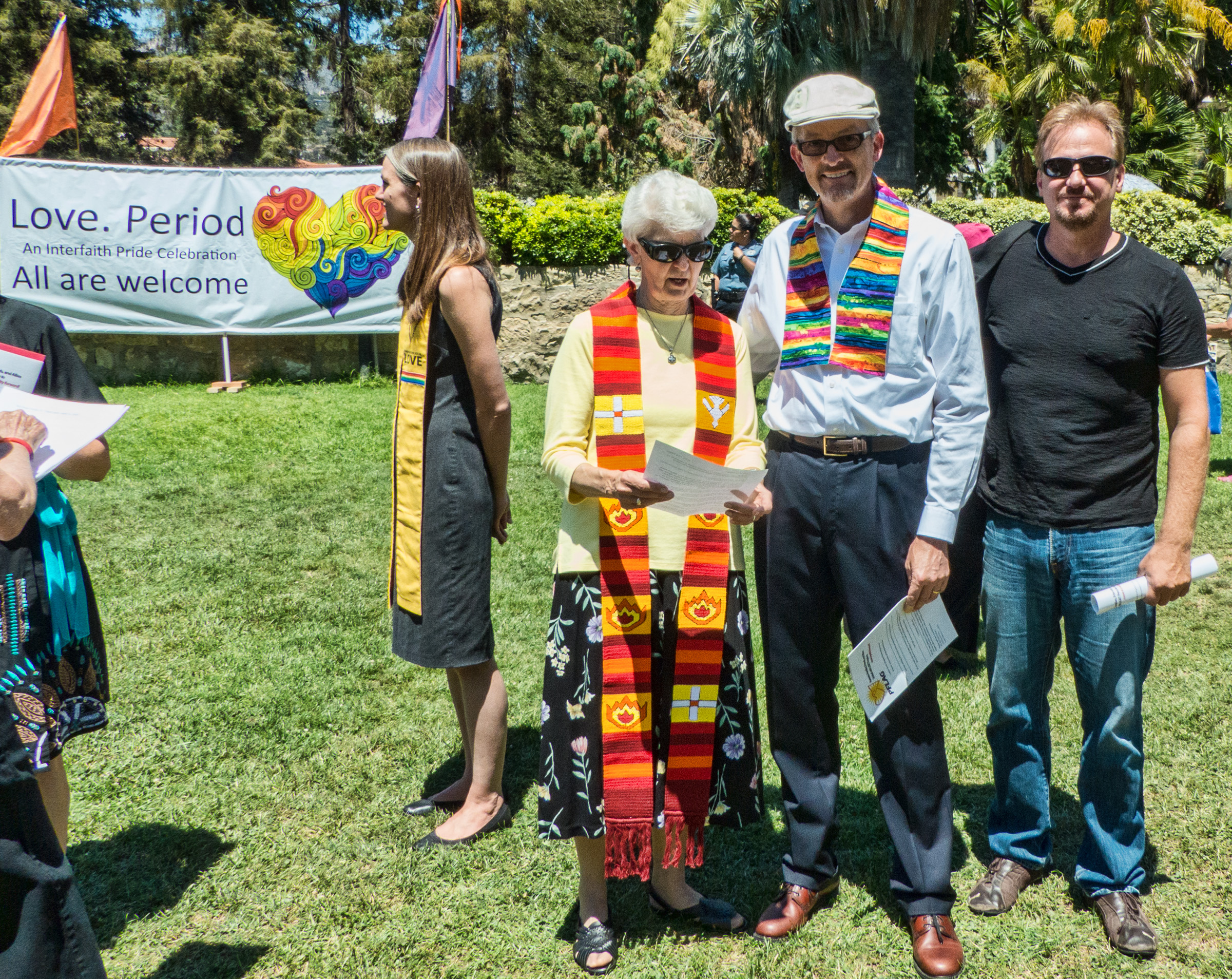
    Love. Period

    21 Tuesday Jul 2015

    Posted by mark lloyd richardson in Justice, LGBTQ, Sermon portions

    ≈ 1 Comment

    Tags

    Christ's body, Confession, gender identity, heterosexism, homophobia, human dignity, interfaith worship, Jesus Christ, LGBTQ community, peace, Pride, sacred worth, sexual orientation, United Methodist Book of Discipline, walls of separation

    Interfaith Pride Celebration Santa Barbara, CA

    Interfaith Pride Celebration, July 12, 2015, Santa Barbara, California

    Members of our church recently participated in the first Interfaith Pride Celebration in Santa Barbara. I was pleased to be part of this outdoor worship service in support of the LGBTQ community. There were about 20 sponsoring faith communities, including ours, and an estimated 250 to 300 people in attendance.

    The reason we were there is simple really – if Jesus were here it’s where he would be. We are Christ’s body on earth and so it follows that we will go where Jesus would go, and we will spend time with people with whom Jesus would spend time, and we will be the bearers of grace and peace to those with whom Jesus would do so.

    It was a beautiful afternoon, with great gospel music and inspiring speakers. I was among the faith leaders who read a Confession written by the Rev. Frank Schaefer acknowledging the wrongs that faith communities have done to LGBTQ persons. We have not always been welcoming and affirming of our LGBTQ brothers and sisters. We have failed as churches and people of faith to acknowledge the human dignity and worth of LGBTQ persons. We, the Church, have treated them as second-class believers and have harmed them with words of exclusion and hatred, defining them as “sinners,” “perverts,” and “abominations.”

    We have not given them their own voice to express their love of God. We have subjected them to abusive “religious counseling” and harmful “conversion therapy” in a misguided effort to fix them. The heterosexism and homophobia of our faith communities has caused real suffering in the lives of our sisters and brothers in the LGBTQ community. John Wesley, the founder of the Methodist movement, told us to “Do no harm.” But we have been doing harm for decades now.

    Following the service, a woman came up to me with a couple of her friends, and with tears forming in her eyes she said, “It was very moving for me to hear the words of confession. It is the first time I have heard anyone say they were sorry for the hurt we have felt. Thank you so much.”

    My heart is with my LGBTQ brothers and sisters, who have been harmed by the Church’s message of exclusion and condemnation in the past. I have been involved over the years in advocating for marriage equality. I have been involved in trying to change the language in the Book of Discipline of the United Methodist Church so that it no longer singles out one group of people based on sexual orientation to deny them the ability to be ordained as ministers or to receive the blessing of the church for their committed relationships. I will continue to do these things because I owe my primary allegiance to Jesus Christ and his reconciling grace and not to the United Methodist Church.

    I want to be unequivocal and stand on the side of love, because as I see it, “love is from God; everyone who loves is born of God and knows God. Whoever does not love does not know God, for God is love” (1 John 4:7-8). “Those who abide in love abide in God, and God abides in them” (1 John 4:16b). As long as I am the Pastor-in-charge in the church I serve, we will be working toward full inclusion of all people in the church’s ministry, regardless of sexual orientation, gender identity, or any other ways we have of dividing people into classes.

    Christ is our peace, my friends. Christ has broken down the dividing wall, that is, the hostility between us. We become people after God’s own heart as we continue this work of tearing down the walls that have harmed others, and indeed have harmed us all.

    Words (c)2015 Mark Lloyd Richardson
    Photo credit: Dallis Day Richardson

    ← Older posts
    December 2025
    S M T W T F S
     123456
    78910111213
    14151617181920
    21222324252627
    28293031  
    « Oct    

    Recent Posts

    • A Familiar Peace
    • At Day’s End
    • How Grace Comes
    • A Blessing for Immigrants
    • Now the Work of Christmas Begins

    Enter your email address to follow this blog and receive notifications of new posts by email.

    Join 356 other subscribers

    Archives

    • October 2025
    • August 2025
    • July 2025
    • June 2025
    • December 2024
    • August 2024
    • June 2024
    • May 2024
    • April 2024
    • July 2023
    • August 2022
    • May 2022
    • September 2021
    • August 2021
    • July 2021
    • June 2021
    • April 2021
    • March 2021
    • February 2021
    • March 2020
    • December 2019
    • September 2019
    • August 2019
    • May 2019
    • February 2019
    • October 2018
    • August 2018
    • June 2018
    • May 2018
    • April 2018
    • February 2018
    • October 2017
    • August 2017
    • July 2017
    • May 2017
    • April 2017
    • December 2016
    • November 2016
    • May 2016
    • April 2016
    • March 2016
    • February 2016
    • January 2016
    • December 2015
    • November 2015
    • October 2015
    • September 2015
    • August 2015
    • July 2015
    • May 2015
    • February 2015
    • January 2015
    • December 2014
    • November 2014
    • October 2014
    • September 2014
    • August 2014
    • July 2014
    • June 2014
    • May 2014
    • March 2014
    • February 2014
    • January 2014
    • December 2013
    • November 2013
    • October 2013
    • September 2013
    • August 2013
    • July 2013
    • June 2013
    • May 2013
    • April 2013
    • March 2013
    • February 2013
    • January 2013
    • December 2012
    • November 2012
    • October 2012
    • September 2012
    • August 2012
    • July 2012
    • June 2012
    • May 2012
    • April 2012
    • March 2012
    • February 2012
    • January 2012

    Categories

    • Blessings
    • Centering Prayer
    • Contemplative Life
    • Dogs
    • grief
    • Guest Blogs
    • Justice
    • LGBTQ
    • pastoral integrity
    • Peace with justice
    • Poems
    • Prayers
    • Reflections
    • Running
    • Sermon portions
    • Uncategorized
    • Worship Liturgy

    Blog Stats

    • 58,806 hits

    Meta

    • Create account
    • Log in
    • Entries feed
    • Comments feed
    • WordPress.com

    Sacred Pauses

    aprilyamasaki.com

    Blog at WordPress.com.

    • Subscribe Subscribed
      • dreamprayact
      • Join 356 other subscribers
      • Already have a WordPress.com account? Log in now.
      • dreamprayact
      • Subscribe Subscribed
      • Sign up
      • Log in
      • Report this content
      • View site in Reader
      • Manage subscriptions
      • Collapse this bar
     

    Loading Comments...